
While we read quite often about the two kings of Indian history with “Great” added to their names – Ashoka & Akbar – the name of Lalitaditya hailing from Kashmir (724 to 760 CE) is generally lost in the pages of history. He certainly was one of the greatest Kings of Indian history who extended the boundaries of his kingdom of Kashmir not only into the plains & peninsular India but also into present day Afghanistan, Central Asia & China.
He was the youngest of the three siblings of King Durlabhka & Queen Srinarendraprabha. Queen Srinarendraprabha hailed from Rohtak. The other two were Candrapida & Tarapida who ruled Kashmir prior to Lalitaditya’s accession to throne after their death.
Lalitaditya Muktapida was a great strategist, a great warrior, an able administrator & a great builder.
He is probably the only king of Kashmir who is reputed to have conquered vast territories of the Indian subcontinent. The victory march of Lalitaditaya Muktapid has been very vividly described by Kalahan Pandit in his book Rajatarangni.
Immediately after ascending the throne of Kashmir, King Lalitaditya consolidated his position within the Kingdom & in the nearby territories. Thereafter he organized his troops & left Kashmir for foreign conquests. It is understood that Kashmiri army also included mercenaries from China & nearby areas of the North-West India. Even those days the Chinese probably had better arms & armaments. These arms & armaments were inducted by Lalitaditya into his army. One of the capable & favourite generals of the Lalitaditya’s army, Chankunya, was of Chinese origins.
As mentioned in Kalhan’s Rajatarangani king Lalitaditya conquered the entire subcontinent from Kashmir to east of India, the Deep South & then the north-western areas. Though there are many historians & scholars who believe that the king of Kashmir, during those days, wouldn’t have had that kind of resources to subjugate such large territories of the subcontinent but there are others who underline that Lalitaditaya Muktapid came to power in Kashmir when the authority of the highly revered Gupta Empire of the country was waning & he got an opportunity to fill in the void caused by the declining central authority. In any case the armies those days did not belong to any one nationality or region but would get organised from amongst the people through the territories of which the victors marched. Some historians are also of the opinion that before proceeding towards central India Lalitaditya had conquered Punjab, Afghanistan & western part of central Asia thus organizing sufficient resources by way of manpower & wealth that enabled him to divert his attention towards the central, south, eastern & western parts of the subcontinent.
The most detailed engagement of Lalitaditya in Rajatarangani is the war between his forces & Yashoverman of the Antarvedi country. He must have reached this area after subduing many kings & conquering their territories along the way. The capital of the Antarvedi was Gadhipur the present day Kambouj or Kanyakubaj. The region lay between Yamuna & the Kali Nadi or Kalika rivers. After a prolonged war Yashoverman submitted to him & offered a peace treaty. The peace treaty couldn’t be signed as the name of Lalitaditya appeared subsequent to the name of Yashoverman on the treaty document. This was not acceptable to the minister of Lalitaditya named Mitrasharman. As such a war ensued in which Yashoverman was defeated. However, Yashoverman & Lalitaditya are believed to have come together subsequently to face enemies from foreign lands. This is considered to be one of the reasons why Muhammad Bin Qasim & his successor Junayad were not able to establish their reign in this part of the country after their victory in the Sindh.
After subduing Antervedi Lalitaditya advanced his forces towards the east right up to the eastern seashore of the subcontinent & wrested Gaud (Bengal) country as well as Kalinga from its rulers.
He moved south into Karnata (Karnataka) which was ruled by Queen Ratta of the Rastrakutta dynasty that ruled Maharashtra from 757 to 783 CE & had brought Karnata under its domain. It is during the rule of the Rastrakutta dynasty that the Kailasa temple complex at Ellora & Elephanta caves were built. From Karnata Lalitadiya turned his attention towards Konkans & later subdued Dwarka & later Pragjyotish (Assam).
While returning back to Kashmir Lalitaditya also passed through Ujjain, Chittor, Marwar & Thanesar. It is also believed that Lalitaditya also subjugated Medapata (Mewar) that was ruled by Guhila dynasty’s Bappa Rawal. Bappa Rawal is believed to have joined Lalitaditya in his Central Asian campaigns where he died. Rawalpindi in Pakistan is believed to have been named after Bappa Rawal.
It is believed that Lalitaditya returned to Kashmir after he came to know that Tibetan king Me Agtsom had invaded Kashmir around 747 CE. Once in Kashmir he repulsed the Tibetans from Kashmir & in fact established contacts with the Chinese kingdom (ruled by Tang dynasty) with the offer that the Chinese may establish a military camp on the banks of Mahapadam Lake (Wular Lake) to thwart the regular threats by the Tibetans in the present day Gilgit, Baltistan region. This offer doesn’t seem to have been pursued later.
During his expeditions outside Kashmir Lalitaditya had accumulated considerable wealth. Once back in Kashmir he utilized it to undertake a lot of construction activities. As per Kalhana’s Rajatarangni he established following towns & cities:
Lokpunya town; located near Lokbhavan spring which goes by the name Larikpura these days, Pamotsa; present day Poonch on the periphery of the Valley, Darpitpura, Sunichchitpura, Phalpura near Parihaspura.
But the town & associated temples built by Lalitaditya that could be termed as the jewel in the crown of Kashmir was Parihaspura. This town was located at the confluence of Jhelum (Vitasta) & Sindh River near Shadipura.
In the temple at Parihaspura were installed several “murtis” of Hindu pantheon. Prominent among them were the “murties” of Parihas Keshva, using around 350 kgs of silver, & another “murti” of Mukta Keshva using 84 kgs of gold. Additionally, gold “murti” of Maha Varha & silver “murti” of Goverdhan Dhar was also installed. The temple had a magnificent pillar in front of it measuring around 125 feet (40 m) with the “murti” of Garuda on top of it.
Lalitaditya started a festival at Parihaspura called the festival of “Sahsra Bhaktas”. During the festival the king would distribute food to 100,001 poor & destitute people & also donate money to them. Another festival that was celebrated during those times was the festival to commemorate the victory of Lalitaditya over the Turks. This festival used to be celebrated on the 2nd day of the Chaitra month of the Hindu calendar.
Kalhana mentions in Rajatarangni that Lalitaditya came to know about some temples buried in a wasteland near the village of Suryavardhaman. The story goes that he came across two girls dancing near the village in the evening with beauty, grace & elegance. On enquiry he was told that this was the custom in the family of the girls in commemoration of temples that were existing near the village. He was told that no one had ever seen the temples, but this custom had been going on in the family for ages.
Next day the king got the whole area dug up & was amazed to find two ancient temples, locked & bolted, buried in the wasteland. The temples had images of Rama & Lakshamana installed in them. From the inscription on plates discovered from the temple it came to be known that the images were installed by Rama & Lakshamana of the Ramayana period. These images were transferred to Parihaspura. Rama Swamin image was installed in a stone temple besides ParihasKeshva temple & the Lakshmana Swamin image was installed by the queen Chakramardika besides Chakreshwara temple.
Lalitaditya’s queen Kamlavati built a market named Kamalahatta. In the market was also built a temple where a silver image of Kamala Keshva was also installed.
In addition to above Kayya, the king of Lata (modern day Kathiawad), also built a shrine of Kayyasvamin. Mitrasharman, a minister of the king built a Shiva temple named Mitreshwara; Bhappata, a teacher, built another Shiva temple named Bhappateshvera. Lalitaditya built Jyeshthrudra, a Shiva temple made of stone. Lalitaditya while going out to conquer various lands in the subcontinent took ten million coins from the Bhutesha temple & offered one hundred million to the temple after his triumphant return to Kashmir from the expedition. Bhutesha shrine is located in the modern day complex of ruined temples in Wangeth ahead of Ganderbal on Srinagar – Leh road.
Lalitaditya & his ministers also built Buddhist shrines & Viharas. Chankunya established Chankunya Vihar which contained tall stupas & images of Jinas. He also established a Vihara in Srinagara. Chankunya’s son in law, Ishanchandra – who was a physician – also built a Vihara in Srinagar.
However, the most significant & magnificent of the temples that Lalitaditya built – the ruins of which even today stand out as the most striking of all the structures of the yore – was the temple dedicated to Sun God built by him at Martand. This place is in south Kashmir in the District of Anantnag. Today the temple is in total ruins. The central structure, the sanctum sanctorum stands tall, without a roof but majestic even in its destruction. It inspires awe. The structure is an embodiment of the talent of the architects & the artisans of Kashmir who absorbed the Gandharan, Greek, Chinese, Roman & Gupta architecture to build such a magnificent structure & bequeathed it to the future generations of Kashmiris. The main temple is surrounded by colonnaded courtyard. It was also surrounded by 84 smaller shrines & gods from the Hindu pantheon are carved out & depicted on the walls & surrounding structure of the temple. Once you stand in the midst of the complex you cannot but just marvel at the dedication & the effort of the engineers & artisans who must have constructed this temple complex but also marvel at the phenomenon that must have resulted in its destruction.
While standing at such a lovely place I couldn’t but try to reflect at those opposing tendencies that result in building of a magnificent masterpiece & at the same time those equally forceful tendencies that desire to see the masterpiece destroyed & damned.
However, murmurs of the brutalized, desecrated & broken down structure are still loud & clear. They tell you a lot about the times of Lalitaditya & its magnificence. While I was walking through the colonnaded corridors I was mesmerized. Neither my tongue nor my pen could express what I was seeing. Its very difficult to find words for such colossus construction & at the same time find words for the colossus destruction. The beams & the columns still rest on each other – at some places normally & awkwardly at others. At many places the structure is ready to give way while at others the majestic strength is overpowering. There are several images of Hindu gods & goddesses carved on the temple walls that have survived the vagaries of nature & destruction.
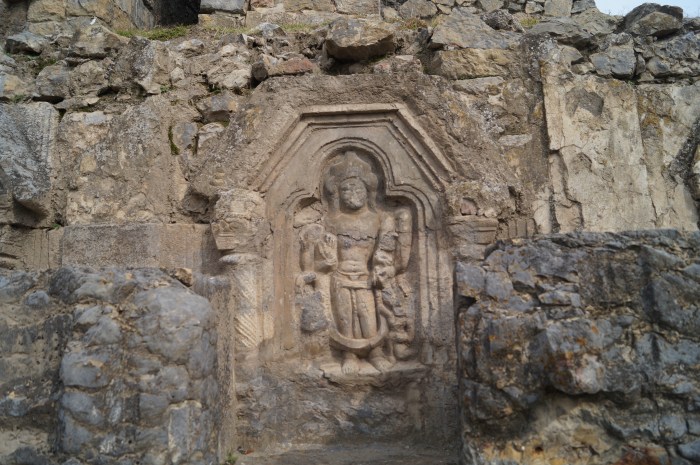
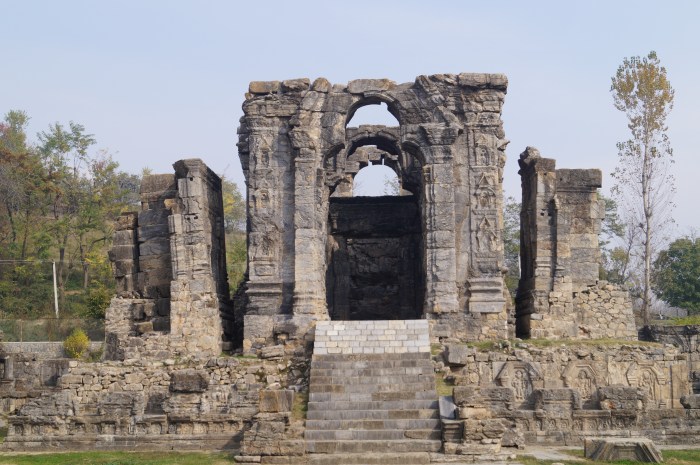
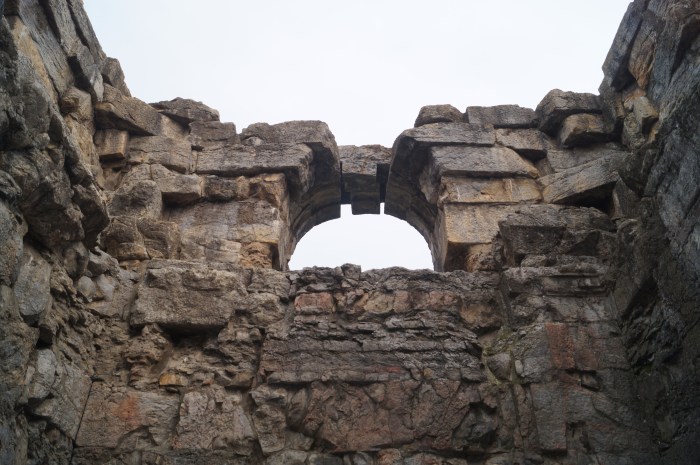
Martand Temple complex mesmerizes – that is all I can say.
Lalitaditya also diverted the waters of Vitasta (Jhelum) for irrigation of agricultural fields near Chakradhara where a string of water wheels were installed. Chakradhara is identified as Tsakdar plateau near Bijbihara. Chankunya’s wife also constructed a well the water of which was considered to have medicinal value.
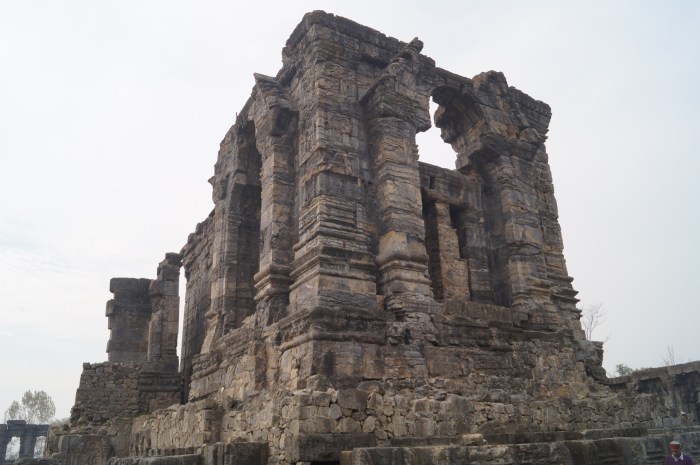
The construction activity under the king is an indication of the prosperity of the kingdom as well as the engineering acumen & artistic taste of the Kashmiri people of the time.
Lalitaditya couldn’t have continued to stay in Kashmir for long. He was ambitious, aspirational & enterprising. The north-western borders of India once again beckoned him. These areas have always been a bane to the political stability of the subcontinent as of Kashmir. He is believed to have moved in the direction of the Tarim Basin in the Xinjiang province of China crossing Talakaman & Gobi desert (Kalahans reference to sea of sand in Rajatarangani). After that no one heard anything about him. The ministers of Kashmir, worried as they were about the safety of the king, sent a messenger to find out his whereabouts. It is believed that the messenger did meet the king & returned to Kashmir with a set of instructions about governance of Kashmir as well as instructions regarding his successors.
Here I will quote from the verses of Kalahana in Rajatarangni about the message that the messenger brought from Lalitaditya to his ministers:
“What is this delusion on the part of men like you that you await my return after I have penetrated this region” (Taranga 4; verse 341)
“After giving up the acquisition of ever new triumphs day after day, what work do you see for me in my own realm if I should return”. (Taranga 4; verse 342)
“For rivers which have set out from their own region the ocean is the limit, but nowhere there is a limit for those who are frankly aspiring to be conquerors”. (Taranga 4; verse 343)
Thereafter the king gives a certain tips about the manner in which his kingdom must be administered so that there is no ‘mishap’ & no ‘blemish’ comes to the rulers. His instructions to his ministers come for an interesting reading;
- He instructs his ministers that they should ensure that there is no dissension within the kingdom as the dissension breeds enemies inside who are more dangerous than the external enemies.
- The dwellers in the depths of the mountains should not be allowed to get extra rich as with their riches they might take over the impregnable forts & cause difficulties for the central government.
- It must be ensured that the villagers have crops just enough to sustain themselves for one season. Keeping this in mind the villagers shouldn’t even have bullocks more than their requirement. For if they have more they will become wealthier & more powerful. Thus they can become a cause of trouble for the king.
In addition to above he gives some more reasons which can enfeeble the kingdom which are enumerated below;
- When the village population has the same facilities & possessions viz clothing, woollen blankets, food, jewelry, horses & dwellings as that of the citizens in the capital city there are chances that rebellion will brew.
- The sure recipe for discontent is if taxes are exacted from only one District to maintain the army & other expenses of administration & are not evenly spread.
- If proper vigil is not maintained at the passes & the fortifications are neglected because of arrogance of the king or because of lack of character of the officers there could be trouble for the kingdom.
- When the civil servants form a league through matrimonial alliances with one another there could be trouble brewing for the kingdom.
- When the king doesn’t apply his mind & complies with the suggestions & recommendations of his ministers, courtiers & his family members it must be understood that the kingdom is running out of luck.
- Activities of royal princes should also be kept under a constant check as they could be another source of trouble.
- Skill & intellect of the people should be understood before assigning them jobs in the kingdom.
He instructs the ministers that his younger son Vajraditya from his wife Chakramardika should not be made the king. However, he insists that if such a situation arises where his becoming king is necessitated his power should not be transgressed & he should always be protected.
Regarding the succession the king mentions that Kuvalyapida born out of Kamladevi should be made the king. However, he advises his ministers, that if he proves to be authoritative the ministers should not hesitate to overstep his authority. Under such conditions if the king gives up his kingship or consequently dies or commits suicide he should not be mourned.
The king had high opinion about his grandson Jaypida & instructed his ministers that in case he becomes the king he should be informed about the valour & governance of his grandfather so that he could emulate it.
Cankunya, thereafter called the assembly of the ministers & other subjects & announced the decisions of King Lalitaditya. His elder son, Kuvalyapida, ascended the throne of Kashmir. Thus, came to an end the tale of one of the greatest kings of Kashmir who left an indelible mark on the history of Kashmir. The greatest emblem of his period that shall always remind Kashmiris about the king Lalitaditya are the ruins of the majestic Martand Temple in Anantnag, Kashmir

 JAGMOHAN SHARMA