Reminiscences (part-II) – Encounter with an Environmentalist:

Reminiscences (part-II) – Encounter with an Environmentalist:

Amarnath cave is one of those serene places where you can feel the presence of God.  This place detaches you from the world & makes you feel at peace with nature. It was an exhilarating experience when we (me, my wife & our daughter) went there on a pilgrimage in 1998. The cave is located at around 12700 feet in the Kashmir Valley. This cave finds mention in the Rajtarangni, by Kalhan, the great book on the history of Kashmir. Amarnath cave has two routes, one via Pahalgam & the other via Baltal. Route from Baltal is shorter & you can go up to the cave & come down to the base camp on the same day with enough time to spare at the cave & witnessing the wonders of nature en-route. On the day of our visit the ‘Snow Shiva Lingam’ was fully formed & you could practically feel the footfalls of the ‘yogis’ who might have travelled to this place over thousands of years in search of peace & tranquillity. Swami Vivekananda is also understood to have come to this cave.

In 2008 this cave & the yatra became a political issue in the Valley as the ‘Amarnath Shrine Board’ that looks after the management of Amarnath yatra was denied a plot of land for constructing temporary dwellings for the pilgrims who travel to this place from all over India for ‘darshan’ of the Holy Cave & ‘Shiva Lingam’. J&K State was on the boil for considerable period of time.

These were tumults times, which are not a rarity in J&K.

It was during this period that a colleague of mine called me up in Jammu from Srinagar to meet a renowned environmentalist of the Valley, in Jammu, with a request to help our organization in getting environmental clearances for a newly up-coming transmission line in the Valley. The gentleman is no longer in this world & as such I am not disclosing his identity.

I reached the house of the environmentalist in Jammu & as the luck would have it he had just arrived from New Delhi & was shuffling into his house with his baggage. It was a hot day & the gentleman, an elderly person, was not in a good mood partly because of the summer heat of Jammu & partly because of my unannounced visit to his residence. I introduced myself to him & he seemed not particularly happy with my name nor with the organization was I working for. This I came to realize later that he presumed that I was an outsider, person not from J&K state, working with the power sector utility that did not belong to J&K State. However, I must add here, to put the record straight that this was my first & last encounter of this kind in J&K state to which I actually belong.

At the outset he rubbed me on the wrong side by telling me that I was talking about environmental clearances for my project but was not even bothered about the environmental degradation taking place in the Sindh Valley & right up to the Amarnath cave because of Amarnath Yatra. I tried to reason with him but he was in no mood to listen.

I thought that my case for environmental clearance for my project is probably now entangled to the Amarnath Yatra row & I may not get anything out of this meeting & in fact it might prove to be counterproductive.

But then the environmentalist also started speaking in rather ‘tough language’ against the agitation launched in Jammu region of J&K for non-provision of land to the Amarnath Shrine Board Trust in the Valley for housing the pilgrims. He also spoke about the intransigent attitude of the Hindus from Jammu & rest of the country in this context. I was taken aback. I was not prepared for this diatribe. I knew J&K state & Kashmir Valley very well & I thought that this issue would also blow off over a period of time.

In my heart I also started wondering as to why religion eventually becomes a reason for division between humanity & communities. All religions of the world speak of one God, however when it comes to the crunch every one speaks about a competitive God, Who is deemed to be their own personal property with intransigent copyrights on that. In the lay man’s language, as per this philosophy, Hindus should be having their own God with similar claims by Christians & Muslims on a God of their own. And imagine if every religion had its own God really than what would happen if the Gods of different religions started claiming proprietary rights on the resources of the universe. As an example, Hindu God initiates a claim on the sun or the moon & the other Gods belonging to different religions start initiating claims on Venus, Mercury, Moon, Jupiter etc. Does it really happen? Sun, moon & the stars shine for everyone alike irrespective of whether they are from one religion or the other. Trees give fruits to everyone & rivers do not ask for the religion of a person for providing water for irrigation of fields. Hinduism, as a philosophy, does not say that their God is the greatest. It, in fact, says that there is only one God though the paths for reaching Him could be different. It is for this reason that you have highly acclaimed saints in Hinduism, Islam & Christianity as well as all other similar denominations of the world. These people realized God by following a path of their own choosing, not through any kind of competition.

Coming back to my discussions with the environmentalist in Jammu who was still not happy with my presence in his house & who was trying to give environmental issue a religious twist I requested him to provide me a piece of paper & a pencil. I requested him to sit down. I placed the piece of paper on a table located in between us & drew two points on this sheet of paper, separated from each other by about three inches. In between these two points I drew a balloon. The environmentalist sat intently looking at my drawing, a very simple one he murmured. I told him that the point on the left represented the time of birth of a person in this world & the point on the right represented the time of his departure to his ‘heavenly abode’. Before the time of the birth of an individual & after his death no one till date has come up with a scientific clue as to what was there for him before his birth & what was going to happen to him after his death. The balloon in the drawing represented the only ‘quality time’ an individual had in this world to prove himself, in whatever field he wanted to. I told him that from the time of the birth of an individual he is brought up with a perception of this world & the world beyond (before his birth & also about the world after his death) based upon the religion into which he is born, in the selection of which he has no role. It is a pure accident or an incident, if you like, that a person is born in a family that is Hindu, Muslim, Christian or any other denomination.

So for a Hindu, Sikh, Buddhist or Jain it is ‘Karma’ of his previous birth & incremental good or bad things he does in the existing life that defines his destiny. For a Muslim, Jew or a Christian birth is a fact of life. For the religions that were born in India a person may find his place in hell or heaven depending upon how he spends his life on this earth during the period he lived here & may also find a place alongside God & may never be reborn if the sum total of his good deeds crosses a certain benchmark determined by God. For religions that were born in the Middle East it is the philosophy of ‘dooms day’ or the ‘day of judgement’ when ‘it is presumed’ that all the dead would rise again & will be assessed on the basis of their deeds in the world & then dispatched to heaven or hell as per the judgement of the  Angels Hafaza.

I told the environmentalist that all these philosophies are based upon the perceptions that a man or woman gathers during his life in the ‘balloon’ between the two points of birth & death. All good deeds or bad are performed during the period between these two points. It is your choice alone to choose the kind of life you want to lead. Lord Rama, Lord Krishana, Jesus Christ, Guru Nanak, Guru Gobind Singh, The Prophet & Buddha chose a life that had a profound impact upon the human society & in many ways elevated it to a new high as per the bench mark of the times in which they lived. They were such great people that millions upon millions of people still follow the path shown by them even after thousands of years of their passing away. I believe that we are not even a speck of dust of their feet to make any comment on these people.

But then why do we bring in competition between these great souls. Who are we to say that who is great & whose God is greater than that of the other when primarily there is only one God? The environmentalist was not impressed.

Sensing this I told him that, finally, I had a very mundane question for him. I asked him that if during the period of the ‘quality life’ that a man spends on this earth a Hindu decides to convert to Islam & than what is the end going to be for him? Would he be reborn, as he was a Hindu by birth or will he wait for the day of judgement for his final deliverance? Similarly if a Muslim converts to Hinduism (the chances of which are very remote) during the course of his life on this earth, will his deliverance be subject to the principle of the ‘day of judgement’ or will he be reborn as per Hindu philosophy as per the law of  ‘karma’? And I told him that whatever perception we might have, but there is no way of confirming the future of the departed as he never comes back to tell his part of the story. He protested & said that a Muslim, a convert or naturally born, shall face the day of judgement. I said it is a perception that Muslims are taught & they grow up with. Similarly Hindus too grow up with a perception that they have been taught & eventually grow up with. That perception is the theory of ‘Karma’.

There was total silence in the room in which we were sitting. I thought that the temperature of the room & Jammu city had risen alarmingly.

I picked up my papers, bade the gentleman a goodbye, the response was almost cold & I left for my office, thinking that the environmental clearance for my project is almost doomed.

After a few months this gentleman called me up. Somehow he seemed to have retained my visiting card. I was surprised beyond belief when he informed me that the environmental clearance for our project had been granted. Today when I remember him I do salute him from the core of my heart.
JAGMOHAN SHARMA

Reminiscences When you are 60+ years & retire from “active life”, so to say, you notice that you have so much to share from your reminiscences. Well, some say that no one is willing to listen to an old man. I am not sure about that yet. From my memory, I recall two incidents in […]

via — JAGMOHAN SHARMA

Reminiscences

When you are 60+ years & retire from “active life”, so to say, you notice that you have so much to share from your reminiscences. Well, some say that no one is willing to listen to an old man. I am not sure about that yet.

From my memory, I recall two incidents in my life when I was confronted on Hindu religion & its beliefs. Not that I was only confronted twice, but these two were challenges in which I could have faced a checkmate. That would not have been a happy situation for me & for the religion in which I was born, which I follow in my own liberal manner & of which I am very proud. In any case liberalism is the core of Hinduism. Hinduism does not believe in a regimented society. There is nothing like going to prayers, in Hinduism, let us say, on every Tuesday. Concept of One God is the core of the religion but you are free to worship any of its formations & creations. That is why the phrase “Aatma is Paramatma”

Coming back to the reminiscences of the two incidents, the first one was in Kullu & the second one was in Jammu.

Here I will conclude my first incident & follow it up with a second one later.

I was posted in Kullu for closer to a year with the assignment of acquiring land for an electric substation so that evacuation of power from Parbati projects was enabled. It was not an easy task as for the past three years or so; no one from our organization was allowed to inspect or visit the land, by a very vociferous section of villagers. Land was to be acquired through a process called ‘land acquisition’ under a legal frame work. In this process the Deputy Commissioner, Additional Commissioner & staff of his office were involved. As such regular interaction with them was a part of my job.

One day a meeting was fixed by the Collectors office & I reached the office at the scheduled time. I did not find the Collector in his office however the Additional DC & his staff were already there. I walked into the chamber of the Additional Commissioner where some people were already seated. I asked about the availability of the Collector & I was told that he shall be available in a few minutes. In a continued process of ‘dissipation of information’ the Additional DC told me that the Collector was a God fearing man & he would go to a particular temple before coming to the office. In the same breath he told me that he himself did not believe in idol worship & also ‘inferred loudly’ that me being a ‘Brahmin’ too I would also be an idol worshiper. The gentleman himself was a Hindu.

All of a sudden the environment took a very different turn & I was in a fix. I was not expecting a question like this at the office of the collector in my wildest dreams.  I was also in a fix as to whether I should reply him or leave the issue & confine myself to the ‘higher goal’ of ‘land acquisition’ sheepishly. Since the statement was made in public, to the amusement of many, I thought it prudent to make my point. I told the Additional Collector that since the forum in which we were sitting was not an appropriate one to discuss this issue so I would reserve my right to reply & would reply to his ‘loud thinking’ surely & certainly.

Soon after the DC came & the meeting started & the ADC was told by the DC to visit the site where we intended to construct the substation.

The ADC told me to join him in his car & no sooner did I take my seat beside him he asked me to spell out what was on my mind about ‘idol worship’& the question he had asked me in his office.

My mind immediately scanned Hinduism for a while. I was not sure as to what should he be told as the  ADC’s annoyance could jeopardise my project as he was a very critical link in the ‘acquisition process of land’ for the substation. This is, generally, how Hindus start thinking once faced with a tricky situation. I told him that I was a ‘Brahmin’ by birth but not actually a ‘Brahmin’ in the actual sense of the word as my job profile had nothing ‘Brahmanical’ about it. I told him that the same was true of every other Hindu in the world today. However, I asked him as to how he considered Hinduism to be rooted in such a narrow & restricted concept that worshiping an idol or not would be considered as a pass or fail test for Hindus, or how this could be considered to be a touchstone of faith for a practising Hindus.

My mind raced over millions of humans who call themselves Hindus in a very broad sense of the word & yet follow their own path to realize the Ultimate without wearing any visible sign of Hinduism on them. They may wear a holy thread or not, may keep a ‘choti’ or not, wear a ‘tilak’ in so many varied designs & colours or may not, may wear a ‘pugri (turban)’, cap (both of varied designs) or not or may generally remain bare headed, may wear a beard & moustache or not, could be vegetarians or meat eaters or may be vegetarian on certain days & non vegetarian on others, burn their dead or may be bury them. They could worship nature, trees, plants, animals, rivers, oceans, mountains, clouds or any other creation of God. They could even worship humans in whom they would find similarities with God, as conceptualized by them over a period of time, since their birth. They could pray to God with their eyes closed or may be open, squatting on floor, sitting in a chair, dancing joyously or in any other way which they thought fit for accessing the Ultimate. Obviously they worship idols & some of them don’t. These concepts might have taken root from the stories they might have heard from their parents, grand-parents and friends or by simply reading books & probably, in recent times, watching serials on TV channels & information provided by inter net & social networking sites. They might even worship every human as His manifestation without batting an eyelid.

They are still Hindus irrespective of whether they go to temples, mosques, ‘dargahs’, ‘peer babas’, gurudwaras or churches. Today you see more Hindu’s in attendance at the ‘mazars’ of ‘peer babas’ on every Thursday than Muslims, for example. They would go to all these religious places with the same reverence as they would go to their own Hindu temples. However they would stick to the basic precepts of Hinduism.

And all of them are Hindus.

All these ideas were racing through my mind & than a thought of Lord Shiva, Shankar Mahadev, electrified my mind. Lord Shiva is one of those concepts of Hinduism which portrays Him to be so easy to please & at the same time so much full of anger.  He is angry when he feels that something has been vitiating the peaceful atmosphere & the environment. Happiness & anger for him are like ‘1’ & ‘0’, binaries, of the modern digital age. The Lord in His pristine glory has been visualized by the poets, painters, dancers & scholars, both Vedic & present, as a figure with long knotty dishevelled hair, with Ganga falling from the skies on to His head. He stands with his feet firmly apart & body fully balanced & anchored to the ground to be able to bear the thrust of a huge column of water falling on His head.  He is in rapt attention. He has poisonous snakes entwined to His neck & other parts of the body, a garland made up of ‘Rudraksh beads’, a new moon resting comfortably on His head as if unaware of the happenings. He has scorpions & leeches wandering around Him, but He is unmindful of all these. They are His playthings.

His throat is blue from the effect of the poison He drank to save mankind while the ‘oceans were being churned’ for their goodies. Under these stressful conditions His companion, the ‘Nandi Gan’, stands firmly with Him & does not want to leave the side of His Master. Lord Mahadev holds His trident in His one Hand & in the other is the “kamandal”, the signs of not taking things lying down & ‘tyag’ – foregoing everything that is worldly.

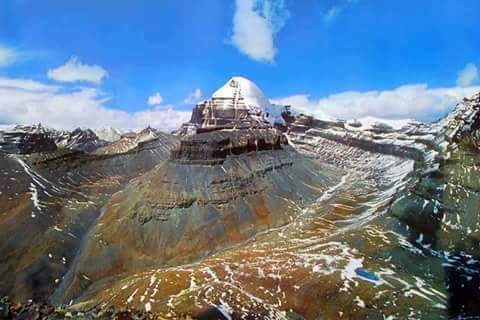
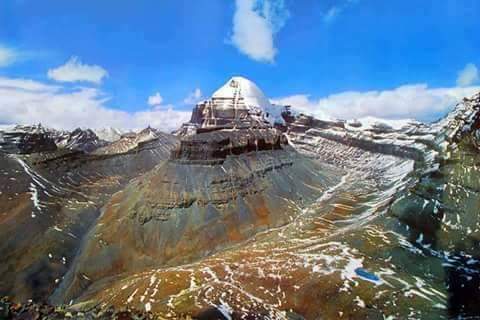
Well, is Lord Mahadeva, a physical form or manifestation of the Himalayas that provide & sustain life in the country called India? There doesn’t seem to be a dividing line & if at all there is one it is obscure & un-discernable.  The Himalayas carry the Ganges through the knotted growth of mighty trees, plants, foliage, herbs, shrubs & flora. Thousands of species of animal & plant life thrive on this creation of nature. Nandi, the bull, companion of the Lord, lives in the same jungles though it is one of the most vulnerable species of the forest. If these jungles were not there the eroded soil from the mountains because of Ganga & innumerable streams & rivers would have filled up the plains of India further down & converted them to virtual desert. Thus this creation of nature further impacts & controls the lives of people in a positive way that live in the plains of India. Moon, full or in any other phases of its periodic appearance, is most beautiful when viewed in the backdrop of the mighty Himalayas. It is unimaginable as to what India would have looked like if Himalayas were not there.

Hence, for Hindus, there is no distinction between the Himalayas & Lord Shankar Mahadev. Thus, how does it matter whether one prays to His image or to this mighty creation of Mother Nature? Both are splendid. That is why millions of Hindus throng the Himalayas, year after year, for having a ‘darshan’ of Lord Shiva at Amarnath, Kedarnath, Badrinath, Gangotri, Yamanotri & Kailash-Mansarovar. They carry water, in bottles or any other vessel at their disposal, from the Holy Ganga flowing through Gangotri, Varanasi, Haridwar & Allahabad to Rameshwaram, thousands of kilometres away, to be poured over the Shiva Lingam consecrated & installed by Lord Ram thousands of years ago.

This narrative to the ADC sitting beside me was enthralling. I told him that with this vastness & depth of the philosophy of Hinduism where does the question of praying to idols or not arise. It is a religion that comes very naturally to humans. There is an overwhelming overlap between Hinduism & nature, the creation of God.

I narrated to him a story of Kagbhushandi to him from the Ramayana.

Ramayana has a character named Kagbhushandi, a crow. He is considered to be narrating Ramayana to the animal world in the same way as Lord Shiva is narrating it to Parvati & Yagyavalik to a congregation of saints. Kagbhushandi was a naughty boy, in an earlier birth under the tutelage of a renowned & well-read teacher. The teacher was a ‘gyani’ in his own right. Kagbhushandi was very intelligent, but always thought that he had better understanding of scriptures & religion than the old & renowned teacher. He had, over a period of time developed contempt for his own ‘guru’.

One day Kagbhushandi was praying to Lord Shiva in a temple & was sitting in front of a Shiva Lingam when his teacher also entered this temple. Kagbhushandi, proud of his own self, did not greet the guru & in fact showed signs of contempt for him. Lord Shankar was annoyed. He was so furious that He repudiated Kagbhushandi to the hearing of the ‘guru’ & asked him as to what was the reason of his pride. How come, He said, you show such contempt for such a renowned & humble scholar who has all the love for you in spite of your misbehaviour. He cursed him that since you continued to sit like a cobra while your teacher entered the temple you should turn into a cobra for all your life.

On hearing the curse from Lord Shiva to his favourite, but naughty & haughty disciple, the ‘guru’ was shaken. He thought that the punishment handed over to Kagbhushandi was far in excess of his misdeed. But what could the guru do? He sat down with his folded hands, in the temple, in front of Shiva Lingam, an idol & went into deep prayers. He requested the Lord that the punishment be waived off from his pupil & the prayer came to be called ‘Rudrashtkam’.

Through this prayer the ‘guru’ beseeches Lord Shiva to excuse his student. Sitting in front of the ‘shiv lingam’, an idol in the temple, he prays that O Lord, who is omnipresent, the root cause of the universe, beyond comprehension & shapeless, without an alternative, all knowing, creator & destroyer kindly pardon the mistakes of my ‘shishya’.

What must be noted here is that the ‘guru’ is sitting in front of ‘shiva lingam’, an idol, but in his prayer speaks about the vastness & shapelessness of God, the omnipresent one. This is the greatness of Hinduism. This is the philosophy. It is surprising that we get into an unnecessary debate about idol worship or not. Unfortunately we get into so many other debates about Hinduism without really understanding it.

The prayer of the ‘guru’ is accepted by Lord Shiva & He says that the curse cannot be reversed, however Kagbhushandi shall have the choice of timing as to when he wants to forsake the existing form of his body & take whichever new shape he wanted with all knowledge of the previous births intact.

It is with this prayer that I closed my discussion with the ADC.

He stayed to be pretty helpful in my official duties & the land of the substation was eventually handed over to us after the due process of law.