Har Ghar Tiranga Abhiyan” – Personal Connect with the Nation

“Har Ghar Tiranga Abhiyan” has become a precursor to the Independence Day celebrations every year. The programme was started as a part of “Azadi Ka Amrit Mahotsav” on 12th of March 2021 and has continued to be the part of the Independence Day celebrations every year. People from every walk of life have been taking part in this programme enthusiastically as proud Indians since its inception.

The importance of being part of this “Abhiyan” was revalidated during my travels recently. My mind was still coming to grips with the realities of Operation Sindoor consequent to the selective killings of 26 tourists in Pahalgam after they were identified based on their religious beliefs. While 24 of the victims were Hindus, one was a Christian as he too could not recite Islamic verse. One was a local Muslim guide too.

The history of the country is full of sacrifices by people of the country struggling for Indian independence, first, and thereafter ensuring that we continue as a democratic nation with head held high and prosper at the same time. The signs of sacrifice are visible wherever you travel in the country.

Recently I was travelling from Jammu to Chandigarh by road and came across Banga town which is located on the Chandigarh – Jallandhar national highway. The town is famous as at a short distance from the town is located the ancestral house of Shaheed Bhagat Singh in the village of Khatkar Kalan. The government of Punjab has renovated the museum on the national highway that is dedicated to the Shaheed-e-Azam and his two other colleagues, Sukhdev Thapar and Shivram Rajguru who too sacrificed their lives for freedom of India. Shaheeds Sukhdev & Rajguru belonged to Ludhiana & Pune respectively.

The story and the sacrifices of the trio are very well known and as such I am not revisiting them. However, coming to be face to face with the photograph of Shaheed Bhagat Singh in his small nondescript house raced my imagination to those times & conditions that must have ignited the spark in the hearts & minds  of these youngsters to dedicate them to take the most difficult decision of their life for trying to pave the way for the freedom of India. The consequences of this decision must have been known to them  & they “drank the nectar of martyrdom” at a tender age of 22/23. Even today their names remain a blessing and a rallying point for all those who love Bharat Matta and desire to work for its all encompassing development.

My travel also took me to the National War Memorial in Delhi which has been laid out a fresh by the Modi Government. The grace, the aesthetics and the heritage as well as the tradition of the country have been fused into each other seamlessly and provide it with an aura of a “Tirath” – a place of pilgrimage. A visit through the memorial leaves you teary eyed. It also makes you proud and generates a feeling of indebtedness to those who laid down their lives defending our nation. Inscribed on the plates in the memorial are the names of the soldiers from the Indian Defence Forces who laid down their lives in innumerable battles that India had to fight with our inimical neighbours since 1947. India had to join the battles not only for maintaining its territorial integrity but also to ensure that the thousands of years of Indian philosophy, culture and traditions not only survive but also thrive to make a mark in the global affairs.

The recent “Operation Sindoor” carried out by  Indian Defence Forces ensured that the terrorist infrastructure across the border in a previously identified locations is demolished. This was the stated objective of the operation in which our defence forces came out with flying colours. India’s intention was not to escalate hostilities, but when Pakistan tried to cross the redlines defined by India it (Pakistan) quickly and decisively had to eat dust. Pakistan’s major airports and other assets were so badly mauled that their airforce was unable to fly the next day. They were compelled to buckle.

However, there were many casualties on Indian side, especially in areas along the Poonch, Rajouri axis where Pakistan used its artillery on the hapless civilian population. The damage was severe. While India went after the terror infrastructure based in Pakistan, Pakistan targeted our civilian population for the retaliation thereby bringing to the fore their evil designs once again.

During the period Indian government gave free hand to the Armed Forces to take suitable action against terror outfits in Pakistan, I came across a post by Smt. Meghna Girish (while she was visiting the National War Memorial, Delhi) on the X platform. This was 3rd of March 2025. She wrote a very touching message which is reproduced herein;

“While paying respects at the National War Memorial last week noticed that the last name engraved is of Braveheart Capt MV Pranjal SC. Our government has given responsibility and free hand to our Armed Forces in terms of ‘mode, timing and targeting’ to avenge our innocents. Let us keep faith with patience. Not push to have many more names of Bravehearts in @Salute2Soldier. Those who have lost know the value of soldiers coming back safe. Jai Hind ki Sena.”

Smt. Meghna Girish’s son, Major Akshay Girish Kumar, was martyred during the Nagrota terror attack on November 29, 2016. He was martyred while leading a Quick Reaction Team of the Indian Army to counter terrorists who had attacked an army unit in Nagrota (near Jammu). His bravery and leadership in rescuing trapped families was crucial and well acclaimed, but he succumbed to injuries sustained during the attack. Smt. Meghna Girish, in-spite of her insurmountable personal loss, has devoted her life to stand as a source of strength to families of soldiers having lost their kith and kin during the wars/terror related incidents.

This post and my lived experiences during last few months and my moments at Shaheed Bhagat Singh’s ancestral house as well as the National War Memorial once again compelled me to think of the thousands who gave up their lives for this Nation, for all of us, so that we could live comfortably in our homes, do our errands & help in nation building in whatever small or big ways we can.

The month of August is on and we shall be celebrating our Independence Day on the 15th. It is important and incumbent on us that we don’t only rejoice and celebrate the great day but also remember those who gave up everything of theirs to keep us secure with a sense of pride for the nation. Let’s remember Shaheeds Bhagat Singh, Rajguru and Sukhdev. Let’s also remember thousands of those like Major Akshay Girish Kumar and Capt. MV Pranjal who never came back to their families but got their names inscribed in the plates of the National War Memorial so that Bharat Matta is able to hold Her Head High. Let’s also remember those whose names must have been added to the Honour plates in the National War Memorial after Operation Sindoor.

Let’s salute thousands of mothers like Smt. Meghna Girish who lost their sons and obviously everything but are ensuring that the unfathomable grief of those like her is marginally made lighter by their untiring efforts. It is not an easy task anyway.

I must admit that I don’t personally know Smt. Meghna Girish, but through her X posts have realised that she is a brave person with lot of conviction and commitment to the families of the armed forces and soldiers.

In the month of August, the best way to remember them and to show our gratitude to the martyrs and to those who lost everything for the Nation is to fly our national flag at our homes, our offices, our business establishments, our parks, our cars, our buses, our trains & wherever we can.

Let’s rally to the call of the PM Modi and join “Har Ghar Tiranga Abhiyan.” Let’s make “Har Ghar Tiranga Abhiyan” a success.

Jai Hind; Jai Bharat

The difficulty of being Shri Ram

22nd of January 2024 is going to be a day written in golden letters in the history of Bharat in general & Sanatan Dharma in particular for on this day Shri Ram will return to His magnificent “worldly home” situated at the place of His birth. This has been possible because of a continuous & consistent struggle & sacrifices by the devotees for close to 500 years. It was an incessant struggle for centuries that took the shape of effort by individuals, collectives & mass movements & finally in the form of the adoption of legal recourse that eventually found its closure on 9thNovember 2019 after the judgement delivered by the Hon’ble Supreme Court of India. 

It is hard to believe that “Ram Lalla”, the “Maryada Purushottam” was denied his own “worldly home” for this long & that too in a land where He has continued to rule the hearts & minds of a vast civilisation for more than 8000 years. Shri Ram has always been present in the consciousness & subconsciousness of every Bhartiya, be she/he from north, east, west or south or from any caste, creed, culture, linguistic or religious denomination. Bhartiyas continue to revere Him as an embodiment of renunciation, fair play, model governance (Ram Rajya) & to top it all, an embodiment of “Maryada.” For Him renouncing the throne of Ayodhya & journey into the jungles (banwas), as per the wishes of His father, was as kosher & normal part of life as His coronation after His triumphant return to Ayodhya after defeating Ravan. He had no remorse at the loss of the throne, nor any delight on His coronation. Worldly attachments had no meaning for him. He was only attached to His Dharma – the path of righteousness. 

During His “banwas” He considered the journey through the challenging jungle pathways, mountains & plains, along with Shri Sita, His wife & younger brother Shri Lakshman, as normal as strolling through the paths of His garden in the Royal Palaces of Ayodhya. Like He didn’t resent the loss of the throne of Ayodhya, similarly he wasn’t upset because of the difficult & treacherous terrain & dangers posed by the ever present “rakshas” that He would encounter during His travels across the subcontinent. He faced the challenges of life, unperturbed under all circumstances & was thus called “Maryada Purushottam” – the most disciplined & greatest amongst men – by the Sanatan civilisation.

When Shri Ram along with His wife Shri Sita & younger brother Shri Lakshman had to leave Ayodhya for a 14 year “banwas” thousands of years ago, He must have felt the first pangs of losing His home, hearth & comforts. 

Shri Ram had just left Ayodhya & had crossed river Tamsa, Ganga, Triveni (Prayag) & Yamuna along the way when He met the great sage Valmiki. Rishi Valmiki was overwhelmed with emotions at the sight of someone whom he knew was “Divine Parmatama” & yet was carrying Himself as a simple wanderer in the forests. Rishi Valkmiki was a “trikaldarshi”, someone who had the spiritual power to sift through the past, present & the future. After bowing to the sage & paying respects to him Shri Ram narrated the reason of His sojourn into the forests. They conversed about “Dharma.” Eventually, like any commoner, Shri Ram asked Sage Valmiki to advise him as to where He should find an abode for Himself in the jungles. 

Sage Valmiki was pained & bewildered by the question. He wasn’t expecting this question from someone whom he knew was an “Avtar” of Shri Vishnu. He was aware that Shri Vishnu had chosen to be in a “panch tatva” body because of His own will to rid the earth of the negative forces. The Rishi went speechless in reverence & after gathering his composure He submitted to Shri Ram in great humility that this question has caused a “dharam sankat” for him. How could he show Him (Shri Ram) a place to live in, knowing fully well that He is living in every being & every nook & corner of the universe & thus there is no space devoid of Him. 

But the great Rishi Valmiki wouldn’t have allowed this opportunity to pass. He must have wanted the posterity in Bharat to remember that Parmatama has His own ways of making home amongst the populace & will choose a space of His own choice. So, where should Shri Ram live? Rishi Valmiki prays & suggests that He (Shri Ram) should find an abode in the hearts of the people who are devoid of anger, pride, attachment, greed & deception. He advises Him to find abode in the hearts of those who are not unnecessarily exuberant on attaining success or are cowed down by difficulties faced by them in the process of helping others. He advises Him to live in the hearts of those who consider fame, or infamy as the same when they are treading on the path of righteousness. He further prays that Shri Ram must live in the hearts of such people who treat other women, the “matra shakti” with the same respect & love as they would to their own mothers, sisters & daughters. 

Sage Valmiki tells Him further that He (Shri Ram) should live in the hearts of the people who are not envious of those who have prospered nor delighted at the discomfort of the others & live with those who love Him more than their lives & consider Him to be the companion, father, mother, guru & the master. Sage Valmiki advises Shri Ram to live in the hearts of the people who discard the bad qualities of their own & pick up the good ones that they may find in others & at the same time anchor their lives on ethical principles, employ good skills for a living & stick to “Maryada” during their sojourn on this earth. He further advises Shri Ram to live in the hearts of the people who abandon “Jaati-Patti”, fame, riches & comforts of the world for His sake.

However, Rishi Valmiki wasn’t unaware of the situational limitations of Bhagwan Shri Ram. He was omnipresent as the creator & One who energised the universe, but in human form He certainly deserved a place to live in. He advised Him to take abode in Chitrakoot, a beautiful place surrounded by mountains, forests, river, water bodies & where flora & fauna was in abundance. Shri Lakshman, the Rishis, the tribals & the forest dwellers of Chitrakoot erected two huts for the new guests. One for Shri Ram & Shri Sita & the other for Shri Lakshman. The huts were built lovingly & with great care out of the wood from the forest trees & covered with bark of the trees, leaves & grass. This was practically the first abode of Shri Ram, Shri Sita & Shri Lakshman in the forests, after they left Ayodhya. Goswami Tulsi Dass in Ramcharitamanas describes the beauty of these huts. Anyone conversant with Ramcharitamanas will realise that the huts built for Shri Ram, Shri Sita & Shri Lakshman in the forests of Chitrakoot was much better than the torn out & filthy tented accommodation in which “Ram Lalla” lived in recent times. 

Today the doings of Mir Baki & Babur have become a matter of the past. Ram Lalla, the Maryada Purushottam, is moving to the newly constructed temple at His birthplace in Ayodhya, but Manthra & Kekyi in multiple “avatars” are still there & leaving no stone unturned to vitiate the joyous & “Ram-maye” atmosphere prevailing in the nation. 

Khardushans &  Kaalnemis will also play their role.

Those who are not equivalent to a speck of a dust of the feet of Shri Ram & may not be remembered a day after they leave their positions of power or probably this earth are abusing Shri Ram, who continues to be the soul & body of Bharat for eons. He continues to stay in the collective memory of Bharat – undiminished & flourishing & He is one of the strings that binds together the multidimensional & multicultural Sanatan Dharma.

Herein lies the difficulty of being Shri Ram!

It is a different matter that whenever a Ram is born there always is a Ravan. However, when the time comes for renaissance, the Parmatama sends Shri Ram, accompanied by His “Ansh” in the form of Sita, Lakshman, Bharat & Shatrughan. Urmila, Mandavi, Shrutkeerti, though less spoken about, but without them Ramayan wouldn’t have been complete. Parmatama, without fail brings in assistance from the likes of Hanuman, Sugreev, Vibhishan, Angad, Jamvant for a good cause & even such small creatures like a pair of squirrels who participated in construction of the Ramsetu connecting Bharat to Sri Lanka.

Shri Ram ensured through his exemplary conduct throughout His life that He had a corpus of good wishes & sincere prayers for Him that came handy in times of adversities. Nishad Raj Guh, Jatayu, Sampath, Matta Shabari, Matta Ahilya & several other saints, tribals & forest dwellers created a wave of goodwill for the good cause of Shri Ram & eventually all the positive forces joined together to defeat the mighty Ravan. 

While the negativity continues to raise its head in some pockets in the country let’s hope & pray, on the occasion of “Pranprathishta” of the temple in Ayodhya, that the positive forces shaping up in the country continue to prevail & firm up so that Ram Rajya becomes a reality in Bharat.

Ayodhya & Ram Rajya as narrated by Goswami Tulsi Das in Ramcharitamanas

I went to Ayodhya for the first time around 2004. That was the time when Ram Lalla, the “Maryada Purushottam”, was housed in a temporary makeshift temple that was covered by a huge, filthy & torn out tent. Since it was monsoon season rainwater was dripping into the area under the tent. It was given to understand that the temple administration had requested the designated Hon’ble Court for permission to repair the damaged tent & that is where the issue rested.

As per court orders the Archeological Survey of India (ASI) had dug up the entire area around this temple to look for remnants of the old temple on which the mosque was built in 1528/29 CE by Mir Baqi on the orders of Babur after demolishing the existing Ram temple. One had to walkover a path that was dug up on both sides with trenches as deep as 3/4 meters. For safety of the worshipper’s menacing iron barricades were installed on both sides of the path. 

The passage to the makeshift temple was through a cage like structure that was covered on all the three sides (two sides & the top) & one could barely walk through it in a single line formation. It was a walk through the cage with monkeys “sitting, stretching, prancing & dancing” overhead bemused at the caged “homosapien cousins” passing underneath.

I went to Ayodhya a second time around 2015. The trenches around the makeshift temple were filled up, but filth was all pervasive. Poverty was visible all around, as was during my first trip & commercial activities in the rundown & ramshackle marketplaces were as minimal as it possibly could be. Lucknow was all glitter & businesslike while Ayodhya was a nondescript town that would go indoors very early in the evening as there was nothing in particular to do for the local populace except visiting some small & big temples.

However, in spite of limitations of infrastructure & other shortcomings there was a constant rush of the pilgrims visiting the temples in the town. They came from all parts of the country. They were from J&K, Assam, Gujarat & Tamilnadu. There was quite a rush at the Palaces of Kekayi (Kanak Bhawan) & Dashrath. Hanuman Garhi was bustling with the Bhakts with pilgrims chanting Hanuman Chalisa & other verses from Ramayan in groups around the “Parikrama” of the temple. We also went to Saryu River where pilgrims were taking holy dip in the river & praying to “Parmatama” in their own ways. The banks of the river were as unclean as they could probably be.

The sight of the Awadh Puri, so dear to Shri Ram, was pathetic to say the least. This was a far cry from Goswami Tulsidas’s description of Ayodhya of “Maryada Purushottam Ram.” How could there be Ramrajya in the ramshackled Ayodhya?

Goswami Tulsidas describes Ayodhya as a beautiful city on the north of which flows the holy River Saryu. The waters of the river are very clean & there are several majestic “ghats” on the banks of the river where the royals & common citizens come for daily chores, prayers, recreation & getting physically & emotionally recharged at the sight of the pristine river. Some of the “ghats” are built for tending to the horses of the cavalry & there are others that tend to the elephants. There is no mud, sludge or slime on the banks of the river. Along the river there are several “ashrams” where saints & divine personages are busy in their “Tapasya & Aradhana” in search of “Gyan & the Ultimate Truth.” The riverbanks are full of “Tulsi” shrubs. There are several beautiful temples on the banks of the river that add to the beauty of the river.

Students – vidyaarthis – are busy with their Gurus who teach them the intricacies of life – from the mundane to the higher levels of knowledge & the truth. 

Royals & citizens have built amazingly beautiful parks, “udyans” & gardens where multiple kinds of flowers, plants, trees, creepers, herbs & shrubs are grown. These gardens are full of flowers & greenery throughout the year. They attract the bumblebee – “bhaunra”, butterflies, birds & animals of various hues. The buzzing of bumblebees is soothing to the visitors & the citizens alike. 

There are peacocks, swans, pigeons & cranes everywhere that beautify the city of Ayodhya. Children raise pets. The pet birds are generally parrots & mynas. Children teach them to speak “Ram, Raghupati, Janpaalak” etc – which are some of the other names of Shri Ram.

The palaces, roads, streets & crossings are beautifully laid out. Markets are also nicely placed & their beauty is beyond description. Prices of goods in the market are such that everything is within the reach of every citizen. Cloth merchants, jewellers, goldsmiths, businesspeople in general & “money exchangers” are honest & believe in ethical dealings. Men, women, children, young & the old are of happy disposition. They are beautiful, healthy, well built & virtuous. 

The town has several beautifully carved out “bavlis”. There are several ponds, lakes & wells that provide clean water for the general populace. The steps to the “bavlis”, ponds & lakes are artistically & aesthetically laid out & there are several step wells too. Ponds & lakes are populated by several kinds of flora & fauna. The chirping of birds is mesmerising. Healthy lotus flowers are providing a spectacular ambiance to the water bodies. 

Raja Dashrath’s palace is magnificent. The ramparts & the walls are fabulous. Several beautifully painted pictures, depicting the lives of the Ikshwaku clan of “Maryada Purushottam” are painted all across the walls. The “attaries” – spires – & “Kalash” of the palaces are so high that they seem to be touching the skies. The floors & pillars of the palaces are beautifully laid out. Beautifully carved & laid out “dehris” are set in several places to light up the palaces & houses of the citizens. Streets & other pathways of Ayodhya are also lit up in a same manner to make life easy for the citizens.

As soon as Shri Ram occupied the throne of Ayodhya there was joy everywhere; the sorrows of the citizens vanished as did the division, discrimination & differences between the people. During the reign of Shri Ram there was no fear or sorrow. Generally, the citizens were healthy & sickness would not touch them as competent “vaids” were available to treat them. Consequently, none would die young & none was in any physical pain. People were competent, educated & “gyanvan.” During “Ramrajya” none was affected by the natural calamities or any other worldly misfortune. Everyone respected & loved each other & stayed within his/her “Maryada.” It seemed as if Indra too operated within his “Maryada” for there was never a very heavy downpour nor scarcity of rainfall. 

There was no poverty & none was sad. People were knowledgeable, skilled & deception was unheard of. People were large hearted & always ready to help & support others in need. The citizens paid special attention to herds of cows. Consequently, there was no dearth of milk & milk products. The fields were always full of crops & the farmers were content & happy. New mines were found from where precious stones were excavated. Natural resources were utilised in a manner that did not impact the nature’s balance.

Truth, charity & piety were the cornerstone of “Ramrajya”. There was no crime in the kingdom of Shri Ram. Using a combination of “saam, daam, dand, bhaey & bhed” the kingdom ensured that the crime vanished from Ayodhya. Consequently, one wouldn’t hear the word called punishment – “dand” – as no one was ever required to be punished.

The taxes were collected very subtly. They would not pinch the citizens. It was said that the taxes in “Ramrajya” were collected in the same manner as the sun gathers water from rivers, ponds & oceans, very subtly, by the process of evaporation & then returns it back to the earth in the form of rains for keeping the life on the planet going.

My visits to Ayodhya were a disappointment because I didn’t see the Ayodhya of Goswami Tulsi Das’s description anywhere. True the “disputed structure” couldn’t be touched till the issue was settled in the courts, but what prevented the powers that be from developing Ayodhya town to the glory as described in the Ramayan?! It was a ramshackle town when I visited it in 2015.

Going back to “Ayodhya & Ramrajya” as described by Goswami Tulsi Das in Ramcharitamanas, I’m sure that I’ve not been able to touch every aspect of the greatness of Ayodhya & the rule by Shri Ram in “Treta Yug” over his kingdom. However, on the auspicious occasion of the “Pranpratishta” of Shri Ram at Ayodhya on 22nd of January 2024 let’s all rejoice & pray that our great nation is able to imbibe the spirit of “Ramrajya” in which there is prosperity all over & following “chaupai” from Ramayan comes true:

दैहिक दैविक भौतिक तापा, राम राज्य नहीं काहुहि व्यापा ।

सब नर करहिं परस्पर प्रीती, चलहिं स्वधर्म निरत श्रुति नीती।

The Sanatan Dharma – as I understand it

I was heading a project named National Transmission Asset Management Centre (NTAMC) when I superannuated from POWERGRID in February 2016. It was a unique & magnificent project as it eventually paved the way for integration of around 275 substations of POWERGRID to main & backup control centres as well as several regional control centres spread all across the country. When I superannuated, we had around 114 substations that had been integrated.


Integration enabled POWERGRID to monitor & control these substations on real time basis, keep a watch on the assets & every component therein through a highly sophisticated visual monitoring network, configure & monitor the intelligent devices including relays, fault locators & event recorders etc & undertake automatic fault analysis. The whole system was integrated through a robust communication network owned by POWERGRID based on MPLS protocol. The substations had automatic access control. The substations too were upgraded as they were commissioned over a period of more than three decades & all of these had varying degree of technology impediments that had to be overcome & made adaptable & in sync with the automation envisaged under the project.


There was a sense of exhilaration amongst the entire NTAMC team when first of our substations were made compatible to the new requirements & confidence started building up steadily that we would be able to achieve the Herculean task in which we were engaged. It was practically unbelievable for an uninitiated that we could access & control the substations located as far as Kashmir, Kerala; Tamil Nadu, Gujarat & various locations in the northeast from Gurugram. The automation was so complete that we could switch the street/switch yard lights of the substations from the central control room, not to speak of the other intelligent elements. We had the sense of being the controllers & operators of the system, albeit under a well-established & strictly implemented protocol. It gave us all a sense of achievement. The icing on the cake was that we had established such a robust system, involving cutting edge technology, for the first time for any utility in the world, over such a large geographic spread that constitutes our nation – India. No other single power utilities in the world overseas such a huge geographical area.


The magnitude of the effort could also be understood from the fact that the system today involves POWERGRID’s 1,80,000 circuit kilometres of transmission lines, 5,12,000 MVA transformation capacity involving 275 substations of POWERGRID with a system availability of 99.86%.


The exhilaration & joy of being able to achieve something on such a large scale was unprecedented was obvious.


But then ISRO achieved something spectacular by the successful launch of Chandrayaan-3. It’s success story in space is unprecedented as the lander landed in the South Pole of the moon – a first for any nation of the world. Watching the Geosynchronous Satellite Launch Vehicle Mark-III taking off from the Sriharikota launching pad was a delight even on a television screen. The mind-boggling sight of the voluminous red, golden & white fumes arising from the launchpad & the consequent thrust lifting the GSLVM-III, carrying the payload, majestically into the skies will remain etched in the memory of Indians for a long time to come. The clockwork precision with which various stages of the rocket ejected & finally the smooth landing of the lander named Vikram & “playful” journey of the Pragyan rover over the surface of the moon was a remarkable achievement in which the whole country rejoiced no end. It was a success story of the rocketry & other stages of the mission, the communication systems, computers & automation, coupled with the determination of the scientists & the engineers to succeed. It was also a delight to know that a part of the POWERGRID’s telecom network was also used by ISRO for communication purposes.


The ISRO control room at Bengaluru, as anticipated, was overwhelmed with joy on both the occasions – when the GSLVM3 completed its mission & also when the lander & the rover succeed in performing their assigned tasks.


Humans, from the beginning of their life on the earth, have been overawed by the creation & the Creator. The universe has always been held in awe that continues to pose unfathomable challenges even today. The planets, the stars, the Milky Way, the black holes & the universe in general has always enthralled mankind. Isn’t it unbelievable that everything in the universe is revolving & rotating & also expanding? There are stars that die & many of them are so distant from us that by the time their light reaches the earth they may have already vanished into the oblivion.


Coming back to the power network automation that we carried out in POWERGRID or the achievement of the Chandrayan-3 by ISRO, there is one thing that is in common to both. Both the institutions have fully manned control centres that direct & monitor the progress of the missions.  We use communication techniques & protocols to control the objects of our own creation. We desire & ensure that they should work in a predetermined manner & a particular fashion. The objects of our creation don’t have a choice unless we put them in auto mode as was done for the lander during its final journey on to the surface of the moon. In any case it was still under the control & command of the control room.


But then, this universe & our solar system is also on the move – constantly. It works to a clockwork precision. There are no mistakes. The software doesn’t fail. The hardware is sturdy. However, the elements of the nature’s “hardware” is constantly churning through a regular cycle of life & death – birth & extinction.

The orbits in which the planets move don’t require repairs (they are pothole free!!) nor does the axes on which the planets rotate need oiling!!


What guides the planets, stars, milky ways, the black holes & other known & unknown multitude of elements that constitutes the universe? What is the secret of black holes? What kind of an “appetite” do they have that they suck everything into themselves. Will mankind ever be able to explore them?!


Surprises galore, but the fact remains that the universe is a reality & it’s unfathomable secrets are unfolding with the advancement of technology. It is also a fact that many times more secrets of the universe still remain an enigma.


Coming back to the same question & that is who is managing this universe ultimately? Where is the Ultimate Governing Power located?

This is the most intriguing question. This question has been intriguing the Rishis & Munis of India for eons. They explored the intricacies of the universe. They gained knowledge & understanding of the orbits, the planets, their revolution & rotation & evolved mathematical formulae, templates & models to pinpoint the location of the planets & analyse their impact on the earth, it’s vegetation, weather conditions, it’s environment & the human & animal life.


These observations resulted in our ancestors predicting the solar & lunar eclipses with clockwork precision. Kumbh melas, that have been celebrated for thousands of years at Haridwar, Ujjain, Nasik & Prayagraj are also related to the distinct positioning of Sun, Moon & Jupiter in the space. The oldest almanac in use, to the best of my knowledge is the “Sapt Rishi Panchang” used by Kashmiri Hindus. The current year as per this Panchang is 5098 (corresponding to 2023/24).


However, were they able to locate the “Adi Shakti” controlling this universe?  They certainly felt & understood the power of the Creator & It’s Benevolence & Its multifaceted dimensions through spiritual quest & resultant experiences. They memorised & jotted down their experiences for the posterity in the form of Vedas & a multitude of other literary works. Were these Rishis & Munis known to each other & did they work in collaboration? Many a times yes & several times no. Geographical spread of the country must have been an impediment. But that is the beauty of Sanatan Dharma. Experiences of realisation of Truth may not be the same for everyone. They could be different for different Rishis & Munis. They could be different for the personages like Raja Janak, who while being a “grahasthi” (family man) & a king too, was detached from the worldly affairs while being just to his subjects. These experiences were different for Maharishi Ravidas, very different for Mira Bai & Chaitanya Mahaprabhu. The experiences of Swami Vivekanand & Adi Shankara were very different too. What to say of the experiences of Maharishis Ved Vyas, Valmiki & Goswami Tulsidas! They jotted down their experiences for the posterity to remember, understand & learn from.


The only common thread between all these experiences of their quest for the Ultimate Truth was the Sanatan Dharma. There are several visible anchors of Sanatan Dharma, but the one that I would call the most commonly seen anchor from north to south & east to west is Shri Ram Bhakt Chiranjeeve Hanuman!! You find him in magnificent new temples, etched in rocks & boulders, in mountains & caves, in the ruins of temples & old forts. You name the place & he is there in one form or another. There are many others too, but this is the most commonly visible & to whom the Sanatan followers relate immediately.


Thus, on one hand we have the philosophically rooted & yet sublime Sanatan Dharma & on the other a simplistic yet omnipresent & commonly understood representation in the form of Shri Chiranjeeve Hanuman.


While Sanatan Dharma continues to explore, understand & find passages to the Ultimate Truth, the puzzle continues to seize the imagination of humankind. This quest is brilliantly caught in the Nasdiya Sukta from the Rig Ved. The “Sukta” tries to explore the same question but is bewildered by the vastness of the Nature’s creation & it’s equally vast & unfathomable secrets.


To underline the point, I take shelter in the English translation of the Nasdiya Sukta by Rayalu Vishwanandha.


  1. Neither existence nor non-existence was there,

Neither matter nor space around

What covered it, where it was & who protected?

Why, that plasma, all pervading, deep & profound?

  • Neither death nor immortality was there,

And there was neither day nor night.

But for that breathless one breathing on its own,

There was nothing else, surely nothing.

  • It was darkness concealed in darkness,

And an uninterrupted continuum of fluid.

Out came in material form and shape,

That one lying deep inside, on its own intent.

  • In the cosmic mind, all pervading,

Desire, the primal seed made its first appearance.

And the wise men, seeking deep in their heart,

Could see the link between ‘that is’ & ‘that is not’.

  • Reins of the link, a grid of crisscross lines,

Holds all the seeds and mighty forces.

Microcosmic forces within,

And macro forces out above.

  • Who really knows, who can declare,

When it started or where from?

And where will the creation end,

Seekers and sought entered later –

And so, who knows when all this manifested?

  • That one, out of which the creation came,

May hold the reins or not.

Perceiving all from above, That One Alone,

Knows the beginning – may not know too.


Rayalu Vishwanandha has beautifully summed up his own translation in following few words:


“In just seven verses, we find ourselves in the ‘no time, no space’ mode gradually reaching the centre of deep darkness, surrounded by smooth, unending plasma. And lo! Out of shapeless nothing, matter with shape emerges”.


The shape that emerges, to my understanding is the universe that we see & observe & of which we too are a small speck in the scheme of things of the Creator.


But then, the question of who created this universe gains an infinite dimension without any clear answers! Who created it, who controls it, who nurtures it & finally destroys it in smaller segments or in many bigger ways. It happens on our planet, but does it happen elsewhere too. For sure, the possibilities are bewildering!!


To my understanding it is something that can broadly be described as “Tatva” which in turn is mobilised into action by the “Cosmic Energy” & the combination plays the “Cosmic Dance” of creation & destruction – many a times unknown to us. This combination of “Tatva” & “Cosmic Energy” is not only self-sustaining, but also nurtures all others. It needs no control room, nor any support system. It is fiercely independent. That is why Sanatan Dharma calls it a “Maya”, something of which we humans are ignorant & unsure, but yet try to reach out to It for It is so enamouring. It is always bewitching to reach out to the Hidden, to the Unknown.


It’s the Dharma of the Ultimate Cosmic Self that holds this universe together. Dharma is the subtle, unseen power that is responsible for the balance, be it the universe or interpersonal relations at a very mundane level. A breach is non-Dharmic! The bigger a non-Dharmic act the worst are its consequences. This is what distinguishes Dharma from religion!


Dharam is the right course to be pursued to keep the system stable. The “system” could be that of an individual, of a collective or that of the universe.


Every component of the universe follows its own Dharma guided by One Single Force; a combination of “Tatva” & “Cosmic Energy.”


Sanatan Dharm texts call this combination of “Tatva” & “Cosmic Energy” as the Parmatman. They also call it Ishwar. As stated in Goswami Tulsidas’s “Rudraashtakam” it is the Parmatman or Ishwar that has no shape, no specific colour, no attributes nor any attachments. It is omnipresent & omnipotent. It has no alternative & it cannot be contained in a finite space. It’s devoid of restrictions of time & space. It’s all pervading. It has no gender either.


The followers of Sanatan Dharma or Hindus worship this Parmatman or Ishwar. They worship It in Its shapeless form or in a form of their own choosing. They worship It in the form of rivers, trees, lakes, mountains, animals & whatever shapes the nature, the Creator, has created. They worship it in the form of planets, moon & stars. They are essentially Nature worshippers.


But the Sanatanis worship Murtis or Deities, too, that many from monotheistic religions find difficult to understand.


Late Governor Jagmohan, in one of his books reflects on Murti puja & explains it very appropriate & convincing manner. He draws on the limitations of a human being & suggests that a Hindu before entering a temple for worshiping the deity would inwardly say:


O Lord, forgive three sins that are due to my human limitations;

Thou are everywhere, but I worship you here:

Thou are without form, but I worship you in these forms;

Thou needest no praise, yet I offer you these prayers & salutations.

Lord forgive these sins that are due to my human limitations.


He further says that by going to a temple, praying to a deity in an attempt to realise It, the human gives It a shape, a habitation & also speaks to It in prayers. It is merely an attempt to secure focus by adjusting the scattered beams of the mind.


Thus, Sanatan Dharma encompasses everything that Parmatman has provided. A Hindu embraces the universe with all its diversities. A Hindu doesn’t necessarily bind himself/herself to one particular stream of thought or living. The Sanatan/Hindu Dharma is not a strait jacket. It doesn’t like, preach or encourage regimentation. It doesn’t preach or practice forcible conversations of others to their own Dharma.


One can wear a tilak on his/her forehead or maybe not, but still, he/she is a Hindu. The tilak can be horizontally marked or may be vertically pasted or probably a simple dot or a small crescent, but for a Hindu it doesn’t matter. A Sanatan/Hindu Dharmi may have a “choti” or not; he may wear a “yagyopavit” or not, he/she may go to a temple, or not & he/she may go to a temple of his/her choosing, his/her own deity & yet he/she is a Hindu. A Hindu can be an agnostic or an atheist, may pray to a deity or may not believe in “murti puja”.


In death a Hindu can be cremated or buried. A Hindu can be a vegetarian, a non-vegetarian or may be a vegetarian on a certain day of a week/year & non-vegetarian on others. He can even be circumcised. He may wear a cap, a turban, a hat or any other type of head gear & he/she can still be a Hindu. He can be bearded or clean shaven or may display multi-fashioned beard.


A Hindu is as comfortable in a church, mosque, dargah or a gurudwara as he/she is in his/her own temple. In fact, there are numerically more Hindus visiting Dargah & ziyarats than Muslims in India. Their reverence for all these religious places is same. They partake “kadha parsad” from a gurudwara, “tabruk” from a mosque, ziyarat or a dargah or the offerings from a church with the same faith, zeal & reverence as they would partake of “prasadam” from a temple of their own. He/she still is a Hindu – a follower of Sanatan Dharma.


Sanatan Dharma doesn’t have one single holy book, but several of them. A Hindu can refer to any one of them, depending upon his/her choice & conviction & circumstances that he/she faces during the course of the life.


This is my Sanatan Dharma – all encompassing, all embracing.


As is evident from the above-mentioned attributes of Sanatan Dharma it is the most secular “way of living, thinking & pursuing day to day life.” Sanatan Dharma doesn’t believe in any regimentation. It gives you absolute freedom to choose your own way in dealing with your life on this beautiful planet.


Does any other dominion do that? None!


Even after such secular attributes the followers of Sanatan Dharma have allowed themselves to be ridiculed & mocked upon. They have not resisted various religions & faiths, political establishments, agents & agencies that try to belittle them or abuse them day in & day out. Somehow the followers of the Sanatan Dharma feel that the Sanatan Dharma has been there since the universe came into being & is everlasting, with a good reason too for it is obvious that the Creator shall always remain in Its Glorious Existence while the dance of life & death on this earth shall continue for all times to come. The Creator will continue with Its task of creation, nurturing & destruction. The planets & the universe will continue following their Dharma & continue to maintain stability & balance. Creator is obviously Eternal!


Thus, Sanatan Dharma is ETERNAL & obviously INDESTRUCTIBLE ,too.


However, what has shrunk is the space on this earth for the followers of Sanatan Dharma. And it is continuously shrinking. This is quite evident from the geopolitical upheavals that have taken place over Bharat Varsha during last few centuries. This shrinkage of space has in fact hastened over the last several decades. That, basically, is the issue. Thus, the fact is that the space is shrinking for the people who are accommodative of diversity & by nature are the most democratic in behaviour & in their day-to-day life. Isn’t this a cause for concern for the Sanatan Dharma followers??


How & why has this situation arisen?

This situation has arisen because the Sanatanis/Hindus don’t react & take guard when someone tries to tread on their feet. They have not defined a line where the abusers must know that enough is enough & stand up to say that thus far & no further.

If Sanatan Dharma has to survive it must define its red lines very clearly & let everyone know the limits beyond which “freedom to abuse” is a complete no….no…! Let us remember the episode of Shri Krishna & Shishupal from the epic Mahabharata.


The tolerant Shri Krishna did not react to 100 opprobrious abuses by Shishupal at the coronation ceremony of Yudhishthir, the Kaurav king but not the 101st. This is what Sanatan Dharma followers need to ponder over.

.


Featured

Smart Electricity Meters – a boon or a bane in J&K

These days smart meters have become a contentious talking point in J&K. Several political parties, social groups & individuals are seen protesting against installation of the meters. You find such protests on streets, digital media & in news papers where the consumers have one or the other form of complaint against the meters. These complaints are generally unverified & unsubstantiated, but more often than not pretty vocal & generally uninformed.

The intent through this write up is to make the electricity consumers aware of the smart meters & why they are important.

Jammu & Kashmir has a unique distinction of being a UT which has AT&C losses more than 60%. AT&C losses broadly define the aggregate transmission & commercial losses of a power utility. This is largest loss for any state/UT of India.

Financially speaking, during the year 2022/23, J&K purchased electricity from the generators to the tune of Rs. 8689 crores while as the collection from the consumers was around Rs.3608 crores, resulting in a financial gap of Rs. 4852 crores. (JPDCL contributed revenue of Rs. 2059 cr. while as KPDCL contributed Rs. 1548 cr.)

Energy consumption in Jammu province was 8460 million units while as the consumption in Kashmir was 11746 million units. The consumption is rising at the rate of 10% per year.

The UT of J&K had to take a loan of Rs. 31,000 crores upto 31st March 2023 from financial institutions to make payments to the generating companies over the last few years & this amount is regularly on the rise.

Thus, on one hand there is an effort on part of the power utilities (JPDCL, KPDCL, JKPCL & JKPTCL) to provide “adequate power supply” to the consumers while, on the other, they lose heavily on the sale of every unit of electricity! Electricity, obviously, is a commodity; a very valuable & essential commodity indeed, without which the modern day life is nothing but hell.

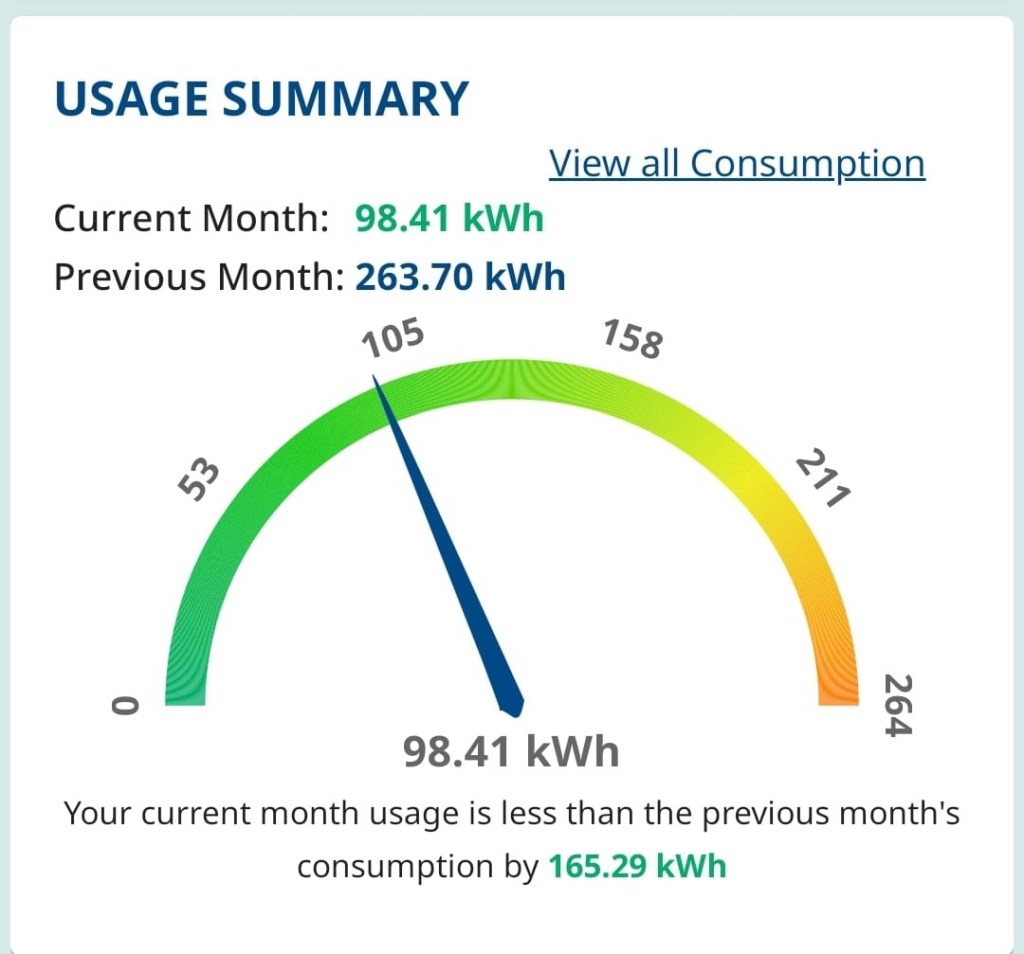
Electricity usage comparison with the previous month

Thus the health of this vital sector is very important for all of us, irrespective of our position in the society.

So, the question is, how could this situation be ameliorated? Smart Meters along with the AB cables (Aerial Bunched Cables) & strict enforcement is the solution. The earliest it is done the better.

By now Jammuites are familiar with the smart meters. They can be seen in every nook & corner of the city installed on electricity poles. Around a lakh of the consumers in Jammu city have their electricity consumption measured by these intelligent devices. I am one of them & I have also switched over to prepaid plan.

Total electricity consumers in Jammu number around 11 lakh. Thus around 10 lakh more meters have to be installed. Same is the case with KPDCL.

Smart meters collect data automatically from the consumers, based on their electricity consumption & transmit it to the control centre based in Bemina, Srinagar. Jammu has a recovery data centre at Gladni. The data received from every electricity consumer is automatically processed at the data centre & bills prepared & raised. The bills are raised on monthly basis if the electricity consumer is a postpaid consumer. The consumer also has a choice to use “BillSahuliyat” application & get the bills as a soft copy. Payments can be made online using debit or credit cards or any of the prescribed digital platforms or by banking route.

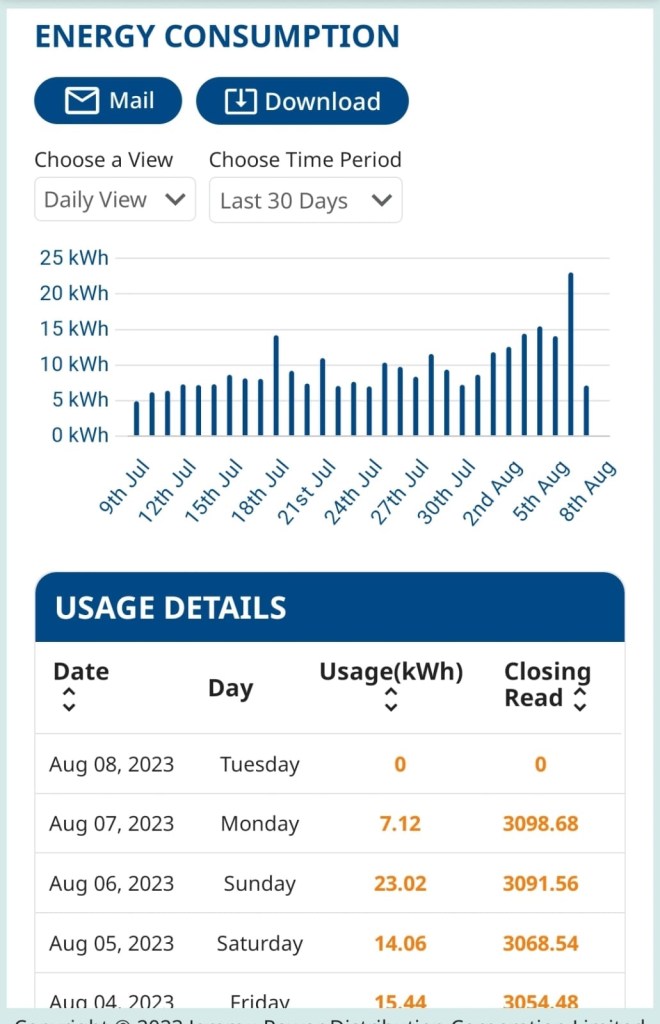
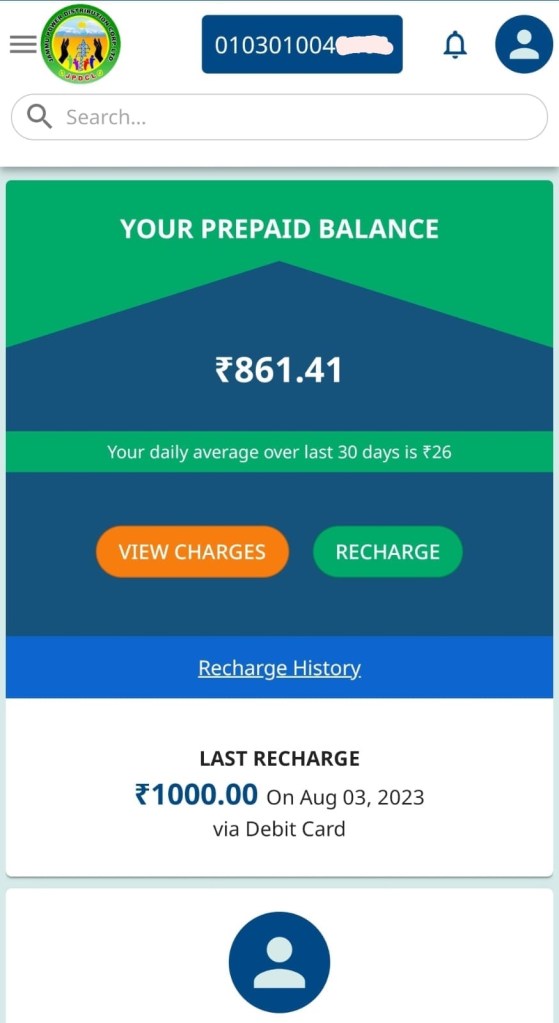
In case of prepaid consumers the data is generated on daily basis & with the help of a web based application on their smart mobile phones the consumers can keep a track of their electricity consumption as well as the actual cost of electricity consumed on daily basis. The consumer can also compare the energy consumed with respect to the previous week or the previous month & can thus manage electricity consumption based on the data available to them on their smart phone.


During the failure of communication link in a particular area the smart meter retains the electricity consumption data of the consumer in its memory & once the communication link is restored the data is transmitted to the control centre & as such there is no loss of data.


Thus, the smart meter is a proven technology. It’s been in use throughout the world since 2011.


India has installed around 67 lakh smart meters in various states/UTs of the country under the GoI’s National Smart Grid Mission. Ministry of Power, Govt of India, has sanctioned installation of 25 crore smart meters by the end of 2025 all across the country. Presently, Uttar Pradesh, with 12 lakh smart meters already in service, leads the states/UTs in installation of smart meters. UP has also placed orders for around one crore smart meters against a sanctioned number of 3.09 crores. Other states/UTs are following suit. Thus J&K is not alone in switching over to smart meters.


Smart electricity meter is a gadget from which an honest electricity consumer must have no fear. The gadget is honest, it’s reliable & any unwarranted variations in the meter readings are visible in the data centre as also on the consumers mobile. Such rare cases can always be addressed & the technology provides methods to address such situations.

Daily energy consumption & daily smart meter readings

Needles to say there is a lot of hard work that goes into installation & commissioning of the smart meters & their integration into the data centre. The back end process of integration of the meters leading finally to generation of electricity bills is presently an ongoing process in J&K as it is in many other parts of the country. These processes take time to fructify & as such the meters are taken into service in batches. In Jammu, for example more than 60,000 meters have been commissioned & are functional. I have personally not found any glitch in my meter since it was commissioned. My bills are generally the same as they were with conventional meter.


Consumers should also be aware that between replacement of the old meter & integration of the new smart meter to the data centre & final generation of the bills it does take something like one to three months. As such the consumers should not get anxious as to why they are not getting the bills for payment once their meters are replaced.

Daily electricity charges

Coming to the most critical & hugely discussed point of conversion of electricity bill payment method from postpaid to prepaid. This method is same as we have in case of mobiles that we use. Like prepaid & postpaid methodology of payment in mobiles we have postpaid & prepaid methodology for the smart electricity meters. If we are comfortable with mobiles, we should also be comfortable with the smart meters. After all it is the same smart electricity meter that can be configured for postpaid & prepaid payment methodology.


The power sector utilities should however create a support & counselling system for the consumers who may encounter difficulties in switching over to prepaid mode from the postpaid mode in particular, but also in case they encounter difficulties in making online payments. In fact there might be several consumers who might not possess a smart phone & email ID that is a prerequisite for registering for online payments. Such people should have access to a system where they can get their issues addressed, respectfully & not receive an “earful.” The power utilities are now commercial companies & the customer should be the most valued guest.

Recharge history & balance amount on a particular day

As of now some of the unscrupulous employees are misguiding consumers & are telling them that the distribution companies have been privatised. This propaganda needs to be countered & the consumers told emphatically that the distribution companies have not been privatised & the private companies are installing the meters as contractors under the supervision & control of the respective distribution utilities. The data centre associated with the smart meters are completely under the control of the distribution utilities & are operated by them.


Thus the smart electricity meters are a boon & not a bane.

They are a boon for the consumers & the electricity utilities as they bring in transparency. We, as citizens, must pay for what we purchase. We must pay for the electricity consumed like we pay for fruits, vegetables, cereals, clothing, school/college fee, smart phones, pads, computers, air conditioners & fridge. We must pay for electricity we consume like we pay for cement, aggregate, sand, paint & wood that we use in construction of houses. It may also be mentioned that J&K has the lowest electricity tariff in country & BPL families have also been taken care of.


Thus, if we want 24×7 quality power, we must pay for it – as a society.


Why celebration of the birthday of Maharaja Hari Singh is important

Why the celebration of Maharaja Hari Singh is important? This question was doing rounds in some sections of Jammu before the Govt of the Union Territory of Jammu & Kashmir announced a holiday to commemorate the birth anniversary of the erstwhile Maharaja of Jammu & Kashmir.

This question to me sounds ridiculous!

It is not only bewildering but causes a heartache for sure. I wonder how skewed is public understanding & especially of those who deliberately want to forget the visible high points of the past. They don’t even tend to recognize the magnificent edifices & emblems of the yore that seem to be crying for attention of one & all by their shear magnificence. And these edifices are extending yeomen service to the people of J&K even today.

Maharaja Hari Singh was coronated in 1925 when the politics of India & the world was in a churn. 1st world war had ended & a new world order was taking shape. The state of J&K, that included Gilgit, Baltistan, Ladakh, Aksai Chin besides Jammu province & Kashmir etc was saddled in one of the most important & geopolitically strategic locations of the world. The borders of the Dogra state touched Afghanistan, Tibet (China), Pakistan (the new Nation) & was separated from USSR by the narrow strip of the Wakhan province.

The state of Jammu & Kashmir was founded by the blood, sweat & tear of thousands of Dogra men, women & children. The rulers ruled this diverse state as justly as was possible during those days of impossible communication & connectivity. Today’s generation that is used to mobiles, cars & other rapid means of transport will obviously not realise the tiring effort of those who carved out the state of J&K almost from the chaos prevailing at that point in history of he region.

In my opinion following are a few of the high points of the Dogra rule, that impacted the lives of the people of J&K for better. The points were establishment of a modern judicial system & compilation of civil & criminal laws into Ranbir Penal Code during the reign of Maharaja Ranbir Singh & land revenue settlement under the indomitable Walter Lawrence hired by Maharaja Pratap Singh as Settlement Commissioner. By this one act, Walter Lawrence mentions in his book (The Valley of Kashmir) that “cultivation extended & improved, houses been rebuilt, repaired, fields fenced in, orchards planted, vegetable gardens well stocked & new mills constructed” (because of improved economic condition). Walter Lawrence further adds that “women no longer were seen toiling in the fields, for their husbands are now at home to do the work & the long journeys to Gilgit are things of the past”. This also shows that “beggar” – the oft repeated blame on Dogra rule – had already come down drastically, if not eliminated, during the rule of Maharaja Pratap Singh itself.

People today forget that before the Dogras came to rule the State, the Kashmir valley, had been through the most brutal & ruthless rule of Afghans who had no respect for human lives not to speak of any respect for rules & regulations – that in any case were non-existent. Sikh Empire too ruled Kashmir for around 26 years but they didn’t have much to offer as the Sikh Empire was already on the wane.

Whenever you look around in Kashmir or in Jammu you’ll find schools & colleges built tastefully during Dogra rule. Amar Singh College, Sri Pratap College, MP School & several other such institutions built by the government of the time. Many missionary & other schools were also established in the Valley. In Jammu the erstwhile Prince of Whales College (renamed GGM Science College), Govt Women College, Parade (Maharani College), Ranbir School & Ranbir Library were established during Dogra rule. There are several schools dotting the landscape of Kashmir & Jammu that were built during the Dogra regime.

Surely, Sheikh Abdulla & his colleagues also went through these educational institutions to Aligarh Muslim University where they got educated in the mould of Sir Syed Ahmed Khan, eventually falling to the trap of the British & the illiterate, uneducated & mysterious rabble-rouser Abdul Qadir who didn’t even belong to J&K. He faded into oblivion as swiftly as he had come to vitiate the political environment of Kashmir.

The Dogra Maharajas also invested in health care. They established Hospitals such as State Hospital Hazuri Bagh & around six dispensaries in different Districts at the time, Sri Maharaja Hari Singh (SMHS) Hospital was established in Kashmir while as Sri Maharaja Gulab Singh (SMGS) Hospital were established in Jammu to cater to the health requirements of the citizens of J&K.

The unmatched Ranbir Canal running through Jammu is catering to the irrigation requirements of the farmers in Jammu even today. Earlier the canal was navigable & people would take joy rides in the cool waters of the Chenab River in the canal. This too was built by the Maharajas.

The Dogra rulers built Mohura power house (on Jehlum river) in Kashmir with a receiving station in Pattan as well & a hydel power station near the present day Bhagwati Nagar which would run on the waters from the Ranbir canal. J&K was probably the 2nd princely state in the country, after Mysore, that installed power generating & distribution facilities. These stations are now in defunct condition though they can be revived with enhanced generating capacities with the availability of new technology in present times.

The foresighted Dogra rulers revolutionised connectivity of the state with the construction of the Jhelum Valley & Banihal Cart Roads thus improving the lives of the people.

It may be noted that J&K wasn’t a resource rich state, but the Maharajas left no stone unturned to ensure that the basic facilities were available to their subjects as much as possible, within the resources available) enabling their march towards prosperity.

1931 was a turning point in the politics of J&K. It was a conspiracy forced upon the Maharaja to push him into a corner for the Nationalistic stand taken by him at the First Round Table Conference in London. It resulted in death & mayhem in Srinagar & heightened tensions further. The Sheikh took advantage of the unfolding situation & communalised it to the hilt.

Meanwhile the Maharaja continued with his social & political reforms, He formed Praja Sabha, that had elected & nominated members & became a precursor to the legislative assembly later. The number of the elected members to this body were proportionate to their population in the state.

From Sept 1934 the elected members started making laws under Praja Sabha. This was also 1st for any princely state of India. He also framed a written constitution for the princely state that came into effect from Sept 1939. He made primary education compulsory & free in the state & prohibited child marriage. He opened all places of worship for the “low caste” subjects – again a first for the country.

In 1937 he was introduced to Jawaharlal Nehru & both became friends & political allies. From there on started a negative phase in the life of the Maharaja & the state. Nehru developed blind faith in the Sheikh & the Maharaja was completely side-lined. Nehru understood the duplicity of the Sheikh later & got him arrested on 09th Aug 1953 but by then the J&K state had gone through immense upheaves & lot of water had flowed down, both in Tawi & Jhelum rivers.

The state raised by the Dogras had ceased to exist; Pakistan had occupied mostly areas from Jammu & some from Kashmir. Gilgit & Baltistan were snatched away in one of the most deceitful operations ever conducted. That Aksai-Chin was also lost to China is a completely different story. Shakasgam was ceded to China by Pakistan.

The might of the then Govt of India & the machinations of the Sheikh were not able to hold on to a state that was built with the blood, sweat & tears of Jammuites/Dogras.

Thus the Dogra state was fragmented factually between 1947 & 1962 & not on 5th Aug 2019 as many would like us to believe.

Coming back to the celebration of the birthday of Maharaja Hari Singh.

The Maharaja was the last ruler of the state & it’s through his signatures that the state of J&K ceded to the Indian Union. As a true Nationalist he spoke up for the people of India in the 1st Round Table Conference in London. He never spoke or went against the people of India or the Indian government. He requested the Indian government to send in troops to defend the people of the state in 1947. He knew his limitations. His army of around 10000 personnel was infinitely stretched & bogged down in Poonch, Uri & elsewhere. Half of his troops had conveniently shifted their allegiance to Pakistan for obvious reasons & killed their trusting comrades in arms unabashedly. The situation was so grim that when the Maharaja ordered Brigadier Rajinder Singh to March to Uri he could barely find 150 personnel from his army to march to Uri. With his 150 people & lots of grit & determination he ensured that the bridge at Uri was blown up & the raiders were halted for a few days from proceeding to Srinagar, the capital city, by his improvised military techniques.

But for inherent love of Maharaja for J&K it’s people & also that for the people of the rest of India he was always projected as a fall guy since 1931 by the powers that be; in fact, it became gruesome after 1947. The contribution of the Dogras, his ancestors, in the creation of the state & their efforts to uplift the downtrodden masses & empower the state were always given a short shrift. It was ensured through concerted efforts at personal & Govt level & with high intensity propaganda that not even a shred of the progressive nature of the Dogra rulers be brought to the knowledge of the people of the country, for then, the powers that be were bound to be asked questions. One of the major questions, that remains unanswered is as to how easily they allowed the dismemberment of the state of J&K?

One of the many & most scathing charges against the Maharaja was that he escaped from the Valley in the face of Pakistan/tribal invasion. Where had he escaped to? Did he escape to UK, the US or any other foreign land or even to the newly independent Indian nation? He was well within his state boundaries, his winter capital.

Where was the Sheikh, the person who spread, propagated & amplified the canard vigorously with an unmatched religiosity & a razor sharp tongue, on the day of the invasion by the Pakistan forces into the Valley? He was already in Delhi along with his family members & returned to Kashmir Valley only after the Indian forces landed in Srinagar & the city was secured.

Regarding the so called escape of the Maharaja from Srinagar, VP Menon mentions in his book (Integration of Indian States) “that the first thing to be done was to get the Maharaja & his family out of Srinagar. The reason for this was obvious. The raiders were close to Baramulla. The Maharaja was quite helpless & if the Govt of India decided not to go to his rescue, there was no doubt about the fate that would befall him & his family in Srinagar. There was also a certainty that the raiders would loot all the valuable possessions in the palace. In these circumstances I advised him to leave immediately for Jammu & take with him his family & his valuable possessions.” He further mentions that he left to his guest house in the early hours of the morning after assuring himself that the Maharaja would leave for Jammu that night. Even VP Menon, Mehar Chand Mahajan, the PM of the state & a crew of 6/7 of their aircraft had to leave hastily for the airport immediately thereafter as they got information that some elements of Pakistan raiders had already entered Srinagar too. VP Menon was the person who worked very closely with Sardar Patel in integration of Indian states

But the propaganda mill would have nothing of the factual position especially when falsehood was being pioleted by the Sheikh himself.

The biases against Maharaja can be better understood if we compare him with the Nizam of Hyderabad where India was facing a war from the ruler. It must be underlined once again that it was a war from the ruler of Hyderabad whereas the Maharaja of J&K had already acceded to India by signing the Instrument of Accession.

The Nizam with a force of around 30,000 personnel, 200,000 razakars, 40000 askars fought battle with the Indian forces. He hobnobbed with Pakistan & imported weapons clandestinely from Europe & Pakistan & loaned huge sums of money to Pakistan for bolstering their war effort against India in Kashmir. He went to UN against India. And finally, when he surrendered to the Indian forces he was allowed to continue as Nizam & finally was made the Rajpramukh/Governor of Hyderabad in Jan 1950.

 Thus, the natural question is as to why the Maharaja of J&K, a Nationalist to the core & who cooperated with the Indian Govt after 1947 was unceremoniously exiled while the Nizam with all his follies & evil intentions against the Indian Nation was made the Rajpramukh?

It is this inherently contradictory attitude of the Govt of India towards the Maharaja & the Nizam that was one of the many reasons of heartache of the Dogras/Jammuites for last 75 years. Holiday to commemorate the birthday of the Maharaja declared by the Honourable LG of the UTJK is a recognition of his services & that of his ancestors to the people of J&K in particular & Indian Nation in general by the government & thankfully it has come at a time when the country is celebrating Azadi ka Amrit Mahotsav.

This recognition will give Dogras/Jammuites a reason to reclaim the glorious past of the Dogra rulers who ruled this state justly & with forbearance. This is surely the first step & not the end, the finality…

AND FINALLY HYDERABAD WAS LIBERATED…

Hyderabad was one of the largest & the richest princely states of pre-partition India. It not only comprised of the present-day states of Telangana & Andhra Pradesh but also of some parts of Karnataka, Maharashtra, Madhya Pradesh & Tamil Nadu. At the time of independence, the state was ruled by Mir Osman Ali Khan, the 7th Nizam.

The Nizam dynasty came to rule Hyderabad after Aurangzeb laid a very long siege to Golconda in 1687 CE & the last King of the Qutab Shahi dynasty, Abul Hassan Thana Shah, surrendered to him. Abul Hassan, a follower of Persianate Shia culture, was imprisoned in Daulatabad where he eventually died.

The state of Hyderabad comprised of a population of around 85% Hindus & 15% Muslims at the time of partition of the country. The nobility, the aristocracy, army & the police of the state were almost all Muslims. The 30,000 strong army of the Nizam was led by Maj. Gen. Syed Ahmed El Edroos, who was an Arab. The Nizam army also included elements that were Arab, Turks, Pathans & Rohillas.

On that critical days leading to 15th Aug 1947 the Nizam decided that he shall strive to make Hyderabad an independent state.

The main actors that played a critical role during this period under the Nizam were Qasim Rizvi & Laik Ali & the organizations; Majis-e-Ittehad-ul-Musalmeen (MIM) & Razakars.

MIM was formed in 1927, initially as a cultural religious organization but soon started following in the footsteps of Muslim League of Ali Mohammad Jinnah in the British India. MIM was founded by Bahadur Khan, a young Jagirdar, with the blessings of the Nizam. Bahadur Khan was a fierce orator & because of his oratorical skills he was bestowed with the title of Bahadur Yar Jung. His oratory laced with militant streak endeared him to the Muslim masses, however he died very young under mysterious circumstances. The control of MIM thereafter fell into the hands of Qasim Rizvi, who was a lawyer from Latur though hailing from the present-day Uttar Pradesh. He too was a firebrand leader who would regularly exhort his followers to remember that they had conquered India by force & they were born to rule.

Well before August 1947 he had raised a 200,000 strong force of Razakars who were armed with all kinds of weaponry including guns. As the date of partition of the country started getting closer the Razakars started tormenting the majority community of Hyderabad who fled for their safety into the jungles & the bordering states of India. Rizvi seemed to have had a complete control over Nizam & proclaimed that in case of a showdown with the new Indian Nation he would ensure that Asafia flag flutters over the Red Fort in Delhi in near future. He exhorted the Razakars to march with sword in one hand & the Holy Quran in the other & annihilate all opposition. This became a huge cause of worry for the majority Hindu population.

Another important character during the last days under the Nizamshahi was Laik Ali. He was an engineer by training & an industrialist by profession who was a supporter of Qasim Rizvi’s MIM & Razakars.

Laik Ali became Prime Minister under the Nizam on 29th Nov 1947. It’s believed that his appointment was a result of his close relationship with MA Jinnah & also because of the pressure put on the Nizam by the MIM/Razakars headed by Qasim Rizvi who wanted their own person at this position because of the continuing stalemate with respect to the status of the princely state of Hyderabad. Before his appointment as PM in Hyderabad Laik Ali was Pakistan’s representative at the United Nations.

Prior to appointment of Laik Ali as the PM another PM was compelled to resign by MIM/Razakars. It was Nawab Muhammad Ali Khan, the Nawab of Chattari & the PM of Nizam. He had to resign as he was not allowed by the MIM/Razakars to leave his house in Hyderabad for a meeting in Delhi regarding the standstill agreement with the Indian government. Such was the dread & clout of the MIM/Razakars at this crucial time in the history of Hyderabad & Indian Nation. It is also believed that Qasim Rizvi had the full support of the Nizam.

The standstill agreement was finally signed on 29th Nov 1947. Agents General were posted in Delhi & Hyderabad; KM Munshi in Hyderabad & Zain Yar Jung in Delhi. A 12-member ministry nominated by MIM was formed which included 04 Hindus.

Qasim Rizvi had complete control over the affairs of the state & because of this there was complete “harmony between King Kothi, the abode of Nizam, Shah Manzil, the PM house & Dar-e-Salam, the HQ of MIM”.

But then the dark clouds of war & mayhem started hovering over the horizon of Hyderabad. Muslim refugees of the partition riots were encouraged to move to Hyderabad so that the ratio of Muslims in Hyderabad was improved & Hindus were terrorized to leave the state.

Nizam had started dovetailing its policies & politics with that of Pakistan & even sanctioned a loan of Rs. 200 million to Pakistan. They had started scouting for weapons, ammunition & armaments from Europe as it was flush with used weapons after the end of world war. Hyderabad also stopped supply of metals to India. In turn Govt of India initiated economic blockade of the state. Nizam also raised a paramilitary force of around 40,000 called the “askars”. The trains passing through Hyderabad to Indian enclaves were ambushed. Razakars continued to harass the population also on the Indian side of the dividing line between the two “countries”. Effort by Lord Mountbatten & Monckton (advisor to Nizam) to settle the issue before the departure of the Viceroy in Dec 1948 bore no fruit & the situation continued to turn grave.

On 17th August 1948 the Nizam sent a delegation to the United Nations to place their case before the security council. The case was eventually closed after Hyderabad acceded to India.

Meanwhile both sides started getting ready for the imminent war & on 13th September 1948 operation polo was launched by the Indian Army under General JN Choudhuri. Resistance from the Nizam’s army folded up by the 17th Sept notwithstanding the bravadoes of Qasim Rizvi.

Hyderabad was liberated on 17th September 1948.

Laik Ali & Qasim Rizvi were placed under house arrest & Gen Adroos was arrested too & later released – being a foreign national.

Qasim Rizvi was sentenced to 7 years rigorous imprisonment on 10th Sept 1950. He was lodged initially in Chanchalguda jail in Hyderabad & later shifted to Yervada jail in Pune as he continued to use his influence in Hyderabad for creating mischief.

On 11th Sept 1957 he was released from the Yervada jail with the condition that he will migrate to Pakistan. Qasim Rizvi was shocked to find that none of his comrades from MIM came to receive him when he was released from jail except Zahid Ali Kamil, his advocate. He was driven to Hyderabad where he called General Body Meeting of the MIM. Only 40 of the 140 members turned up. He tried to persuade some of the members present to take over the presidentship of the MIM. None came forward.

Finally, probably unilaterally, he announced the name of Abdul Khair Siddique, who had been secretary of the party & a criminal lawyer too to take over the leadership of MIM, but he politely refused.

Finally, it was Abdul Wahid Owaisi, the grandfather of Asaduddin Owaisi (the present MP of Lok Sabha) who was nominated to head the MIM. The party was later rechristened as AIMIM. Dar-us-Salam, the head quarter of MIM (built on 4 ½ acres of prime land) during those atrocious days of rape, murder & loot by Razakars before Hyderabad’s liberation, was returned to AIMIM by Neelam Sanjeeva Reddy, the then Chief Minister of the state along with the rent for the period during which the state government used the premises.

On 18th Sept 1957 Qasim Rizvi left for Pakistan where he grew completely disillusioned & died a pauper’s death.

Laik Ali & his family’s escaped from the house imprisonment in one of the most dramatic escapades of history. The Govt of India came to know about their escape only when he appeared in a reception in Karachi & was introduced to the Indian High Commissioner. Suffice to say now is that when the curtained car of the Laik Ali’s wife, who was on her escapade, broke down near the Begumpet airport her cousin tried to push it to start. It so happened that the Police Chief of Hyderabad was passing by & presuming that there was some lady in distress he asked police officers in his escort to help them push the car to start it. The escape was perfect!!

Laik Ali died in New York where he was on a Pakistan government assignment & was buried in the Holy city of Madina as per his will.

Well, what about the Nizam?

Gen JN Choudhuri, the military administrator took control of the Hyderabad State on 18th Sept 1948, but all government orders (firmans) continued to be issued in the name of the Nizam till 25th Jan 1950. As the constitution of India came into force on 26th Jan 1950; the Nizam was confirmed as Raj Pramukh (Governor) of the state.

A comparison with Maharaja Hari Singh of J&K wouldn’t be out of place at this juncture. While the Nizam fought a battle with the nascent State of India with the likes of Qasim Ali & MIM/Razakars on his side he was rehabilitated & made Raj Pramukh.

Maharaja Hari Singh, a Nationalist to the core & who strived to help his subjects in matters of education, justice, health care, eradication of social evils like untouchability, allowing the downtrodden people into temples, agriculture & establishment of power sector in J&K. He declared on his coronation that his religion was “Dharma”. Such a benevolent & foresighted ruler was exiled from J&K on 20th June 1949 because of the “bonhomie” between Nehru & the Sheikh. He was never allowed to come back & it was only his ashes that returned to his beloved state after his death on 26th April 1961.

At the first round table conference in London in 1930 Maharaja Hari Singh declared that the Indian Princely states would join an “All India Federation” & pleaded for equal status for Indians in the British Commonwealth of Nations.

Therefore, the declaration of holiday by the Honorable Lieutenant Governor of J&K to mark the birth anniversary of the Maharaja Hari Singh on 23rd September makes complete sense. We, as Jammuites would like to thank Shri Manoj Sinha ji, HLG, J&K & the Administration under him & congratulate him for the decision. This decision, small as it may sound, formally rehabilitates the memory of the Great Nationalist Maharaja – that was Hari Singh – after a span of 75 years & allows Jammuites to reclaim an important part of history that is being pushed continuously into oblivion by the powers that be.

Audacity of Daksha Prajapati – the Shiv denouncer  &  the rage of Shiv Mahadev

This is a very popular story from Hindu tradition & is mentioned in several Hindu religious texts. However, here I will rely on Goswami Tulsidas’s Shri Ramcharitmanas.

Mother Goddess Uma was sad & anxious as her own father, Daksha,  had not invited her or Shiv Mahadev to the “Yagya” & festivities organized by him to celebrate his elevation to the position of Prajapati – King of the people literally.

She was distraught at not getting the invite, but requested Her husband Shiv Mahadev that She should be allowed to go as going to her parental house, as She thought, didn’t necessarily call for an invitation.

THE DAKSHA YAGYA

Shiv Mahadev tried to reason with her that going to any such function, uninvited, was not right but she was adamant. Finally, He organized an escort of Ganas (body guards) & deputed His Nandi to take Her to Her parental house where festivities were in full swing. En-route She could see Devtas, Rishis & several other invited guests proceeding to her parent’s house, many in procession.

On Her arrival at Her parent’s house She found that the response of Her father & other family members towards Her was unwelcoming. Rather She felt ignored. Only Her mother welcomed Her.

(the story goes that Daksha did not like Shiv Mahadev because of his ascetic nature etc; but that story is for some other day)

When she entered the arena where “Yagya” was to be performed she found that no place was reserved for Shankar Mahadev. The space should have been marked out, normally, even if He had not come there physically, as per the tradition in vogue.

Mother Uma was enraged. She denounced Her father, Devtas, Reshis  & all others who had gathered there for the “Yagya”. She said that no “Yagya” was complete without due respect being paid to Shiv Mahadev.

She declared that She was unable to bear with the disrespect shown to Shiv Mahadev by Her father. She thundered & told those who tried to  argue with Her & wanted Her to calm down & understand the peculiar situation that it was unbecoming of any society to compromise on disrespect shown to Shiva & thus settlement through logical arguments had no meaning. She rebuked all the participants in the ‘Yagya” & announced the following in disgust:

“Listen carefully, all of you in the gathering; all of you who spoke or listened to the disrespectful words against Shiv Mahadev. (wittingly or unwittingly too)

You’ll face the consequences of what you’ve done; my father will also repent for his undoing,

Listen all of you who are gathered here; anyone who speaks in derogatory terms against Shiv, Vishnu or the saints,

Their tongues should be pulled out & slashed (if you have the capability to do that); or you should plug your ears & leave the gathering (where Shiva is being spoken against),

You must remember that Shankar Mahadev is the Conscious Keeper of the universe & by nature is benevolent & looks after wellbeing of all,

My father, a dimwitted person, has abused Shankar Mahadev with his nasty actions; it’s unfortunate that I am his daughter,

Since I cannot bear with the abuse & disrespect of Shankar Mahadev by My father; I will leave this world with the image of “Chandramouli” (another name of Shiv) permanently etched in my heart”

Saying this Mother Goddess Uma consigned herself to flames ignited by energies commanded through “Yoga”; causing great commotion in the gathering & everyone started running helter-skelter fearing the imminent wrath of Shankar Mahadev.

When the Ganas accompanying Uma saw what had happened right in front of their eyes they fell upon the gathering of Devtas, Rishis & whatever else they could lay their hands on. The “Yagya” was saved by the timely intervention of Bhrigu Rishi.

When the news of “Sati” by Uma reached Shankar Mahadev he was enraged & uncontrollable. He dispatched his “Gana”, Virbhadra, to avenge the “Satidom” of Uma. Virbhadra destroyed everything that he came across at the location of the “Yagna” & eventually seized Daksha, the father of Uma. He beheaded him & threw his head into the flames of the “Yagna”.

This is a well known story, so says Goswami Tulsidass, & that is why, he says, he has kept it short.

VIRBHADRA & DAHSHA

AVANTIVARMAN – the great king of Kashmir

It is very rare that you come across a scene or a landscape that leaves an indelible imprint on your mind & ignites a spark for you to explore & reflect.

As is usual during this time of the year one could feel, smell & hear the footfalls of spring in Kashmir. Almond blossoms were in full bloom. It was an unforgettable scene as buds of the leaves were struggling to set themselves free to take shape of beautiful leaves on a variety of trees, plants, bushes, shrubs & the wild that abound the Valley. However, it was almond blossoms that occupied every plausible space that was visible to human eye. The spectacle was amazing & heavenly.

On such a day I was travelling from Anantnag town of Kashmir towards Srinagar – the summer capital of the Union Territory of Jammu & Kashmir – that is famous all around the world. River Jhelum, in some of the stretches of the road would come closer to the national highway on the left side & at times drift some distance away. The landscape of almond blossoms mentioned above was on the right side; all along the gentle slope of the hills & the “karevas” – the highlands.

It was a cool but partially sunny afternoon – which in weatherman’s language meant that occasionally it would get sunny; while in between it would start drizzling. Thus the mood & weather – both were upbeat.

While passing through the town of Avantipora I caught sight of the magnificent white building of the Jama Masjid on the right side of the road. As it had to happen the angle of observation was such that in one sweep of my eye I could scan & internalize the grey ruins of the Awantiswami temple dampened by the nightly rain enclosed in an equally grey iron fencing – at a level lower than the national highway as if standing in a huge abandoned cavity in the earth, interspersed with leafless but a majestic Chinar as well as Poplar trees. The mosque stood at a higher elevation at the far edge of the cavity in which the ruins of the temple stood.

The visual effect & its impact triggered an old saying in my sub-conscious mind; ‘new civilizations are always built on the ruins of the old ones’. There couldn’t have been an apt & timely demonstration of the saying than the location of the ruins of the temple & the newly built mosque on the same physical plane.

The sweeping gaze of the two structures, one majestic even in ruin & the other in organically throbbing & majestic splendor, on that fateful cool spring afternoon led me to Avantivarman, one of the greatest Kashmiri Hindu Kings who ruled the Kingdom of Kashmir from 855 to 883 CE. A short distance away from this temple are the ruins of Avantiswara temple built by the same great king of Kashmir.

Avantivarman was the first king of the Utpala dynasty that ruled Kashmir after the end of the Karakota dynasty – the dynasty of King Lalitaditya, the builder of Martand temple dedicated to Sun.

Reign of Avantiverman (855 – 883 CE) was like a balm; not only on the aching body politic of the kingdom of Kashmir but also to its social & cultural life. This was the period when the king did not undertake any external expeditions. He used his time & resources to consolidate the internal security situation & concentrate on the development of his kingdom. The result was that the people during his reign were happy & prosperous.

In the beginning of his reign though, the king had to bring his own revolting & unruly brothers, cousins & nephews to book. There was trouble also from merchants who had acquired position bigger than that of the king on account of the wealth accumulated by them through unscrupulous means during the later period of the Karakota dynasty. In many cases they had also taken possession of some of the villages through their own retinues. In this task of kingdom building he was ably assisted by his minister named Sura who had also helped him in taking over as the King of Kashmir. He appointed his step-brother Suraverman as his Youvraj & assigned him powers to help him rule the kingdom justly.

One of the greatest achievements of the reign of Avantivarman was to make Kashmir reasonably free from the menace of perennial floods. In this endeavor he was ably assisted by Suyya, a practical engineer of his times. He had discerned the cause of the floods in Kashmir & then planned & weaved a solution that he thought was consistent with the psychology of the people. Though the people thought that Suyya was a mad person, as he would consistently narrate to everyone he came to know or came in contact with him that he had a solution for stopping perennial floods in the kingdom but didn’t have the resources. When the king came to know about it he provided him with Dinnara coins as per his requirement. Suyya went to the place called Yakshdara (present day Khadanyar) where boulders, unhinged from the adjacent mountains, had blocked the path of the waters of the river Jehlum. He threw the coins provided to him by Avantivarman into the river in full view of the villagers. The onlookers & villagers jumped to fish out & gather coins from the river & in the process removed the boulders that had blocked the flow of waters. The exercise was continued till the time flow of water became obstruction free. He followed it up by throwing the coins into the river & the mouths of the Wular Lake. People continued their “dutiful exercise” of fishing the coins out of the river along with sand & silt of the lake. In this process the river was dredged at the locations where silt & sand had settled down on the river bed or the lake thus causing floods. Suyya strengthened the embankments of the river were the chances of falling boulders from the adjacent mountains was more. He also stopped the flow of river for seven days with the help of a dyke & dredged the river in stretches that required removal of accumulated sand & silt. His method continued to be the same.  He threw coins into the river & the villagers looking for the coins continued to dredge the river by bringing out basketfuls of sand & silt & depositing it along the embankments.

He constructed suitably designed canals to drain water from the swamps into the rivers thus bringing in more land under cultivation of agricultural products. A network of canals was created emanating from the rivers & streams & channelized for irrigation of land where eventually rice was grown.

A greater feat even by today’s standards was the creation of the confluence of Sindh & Jehlum at the present day place called Shadi Pora. It is said that earlier the area around present day Lar & Ganderbal of the Kashmir valley would get submerged because of the waters of Sind Nullah causing devastation during floods. These floods had laid the land in these areas completely waste.

These steps resulted in reduction of floods in the kingdom, the people produced bumper paddy & other crops and these commodities were available at considerably reduced prices. Kalhan mentions in Rajatarangni that the price of paddy for a particular local measure of weight (Khari) came down from Dinnaras 200 to Dinnaras 36. The price of one “Khari” of paddy during the later years of the reign of the kings of Karakota dynasty was around 1050 Dinnaras. In fact Lalitaditya Muktapida of Karakota dynasty had also taken some steps to control floods in the kingdom but they were abandoned by the later kings & in fact nothing was done to keep the already constructed facilities in operation.

Thus there was a sense of overall prosperity & wellbeing amongst the people of the kingdom. This resulted in enhancement of the popularity & prestige of the king.

King Avativarman along with Suryaverman, his stepbrother; Sura, his minister & Suyya, the engineer had put the kingdom of Kashmir on the path of peace, development & prosperity after a pretty long time in its history.

Prosperity also enabled diversion of the attention of the officials & ministers in the direction of construction of temples, viharas, muths & convents for piety. Before being crowned the king of Kashmir Avantivarman had already constructed the Avantiswamin temple – the ruins of which I had come across while travelling to Srinagar. After becoming the king he built the temple of Avantiswara. These temples were built by him in the town named Avantipura which was built by him. The name Avantipura for the town was derived from his own name by the king. This area was earlier called Visvaikaswra – which means a place that gives salvation to anyone who dies here. The town is located in one of the most picturesque spots in the Kashmir valley with river Jehlum skirting it on one side & on the other side are the hills gently sloping & merging seamlessly into the outer peripheries of the town giving it a serene look.

Some of the temples were constructed by Sura the most trusted minister of the king. Sura was so much devoted to the king that he was unmindful of his own life or that of his own family & was devoted to the wellbeing of the kingdom & the king.

He built a temple dedicated to Parvati & Shiva on the banks of the world famous Dal Lake in Srinagar. This temple is believed to have been constructed near the village of present day Ishber or Gupt Ganga. The temple was also provided with a permanent endowment. This area has continued to be a place of spiritual pursuits for Hindus especially following Kashmiri Shavism. Abhinav Gupta (950 – 1016 CE), the great Kashmiri philosopher, mystic, musician, dramatist, poet & proponent of the philosophy of Kashmiri Shavism is also belived to have lived here. Subsequently Swami Lakshman Joo (1907-1991 CE), a great philosopher of Kashmir Shaivism in his own right lived in Gupt Ganga in the Zabarvan Hills initially & later on at his ashram at Ishber – a few hundred meters from the famous Nishat gardens. Unfortunately, the great ascetic too did not remain unaffected by the turmoil in Kashmir of 1989/90 & finally passed away at NOIDA in the state of Uttar Pradesh in 1991. NOIDA, though in UP is on the periphery of Delhi.

Kavyadevi, wife of Sura also built a Shiva temple near Suresvari & named it Kavyadeviswara. Sura’s son, Ratnavardhan, too built a temple of Bhuteshwara in the same area with a convent inside the Suramonestry. Sura also established a town near present day Shopian named Surapora which today is called Hir Pora. Those days this territory was called Kramavarta & it is quite possible that Kulgam today has connotation of the same name.

Principal doorkeeper of Sura named Mahodaya also built a temple built Mahodayaswamin.

Not to be left behind the step brother of the king & Youvaraj, Suraverman, also built Suravarmaswamin & Gokula temples. He granted “agraharas” of Khadhuya & Hastikarna.

In short, during the reign of Avantiverman many temples & towns were built by the members of the royal family, the Youvraj  & the ministers thus giving an impetus to the economic activity. A few of these places exist as ruins even today & where ruins are nonexistent the philosophy & association of Kashmiri Shaivism has continued to be a part of those pockets such as Ishber & Gupt Ganga on the banks of the Dal Lake.

Sura once again started the spread of education that had got once again stalled because of turmoil & unsettled conditions of the kingdom of Kashmir. He made it a point to honour the men of letters & made them members of the king’s council. Some of the poets mentioned by Kalahana in Rajatarangni, who were made members of the kings council by Sura were Muktakana, Sivasvamin, Anandavardhan & Ratnakara.

They were given special privileges & incentives to encourage them to pursue matters of scholarship.

Kalhan in Rajatarangani mentions that Ramata, famous for work on grammar, was appointed a preacher in a temple.

Avantiverman banned slaughter of animals for a period of ten years in the beginning of his reign. Why this period was fixed as ten years & what happened thereafter is not known. Killing of birds in the present day Wular Lake called Mahapadma was also prohibited by Suyya. This lake became a sanctuary for birds of various types & variety. 

Suyyabuit a town downstream of the outlet of the Mahapadma Lake & named it Suyyapur which in modern times is famous by the name of Sopore. Suyya’s mothers name was Suyya too. He built a bridge over river Jehlum in her name. It is said that the lady, Suyya, who belonged to Chandala caste, had found a newborn baby in an earthen pitcher the mouth of which was covered with a lid. After enquiring about the mother of the child when no one came to claim him she took this child to her home & brought him up in poverty & misery. This child was also named Suyya after his mother (the lady who had adopted him). However, he proved to be well ahead of his times & was able to resolve the perennial problem of flooding in the kingdom of Kashmir. Some lesson for engineers, town planners & administrators who could neither foresee nor prevent or manage the city of Srinagar during the floods of 2014. It is worthwhile to understand that Suyya had neither the education nor the knowledge, technology or resources in the 9th century CE that were available to the administrators & engineers of Kashmir in 2014. Suyya didn’t have the advantage of Google maps, drones, internet or technological tools that are available to us now but still was able to make Kashmir reasonably free from perennial floods. Suyya was committed person & that is the truth.

When time came, Avantivarman realized that he was not going to live any longer. He retired to Jyesthesvara (present day Shankracharya) & while listening to verses from Bhagwat Gita left this world.