King Lalitaditya; the Great

While we read quite often about the two kings of Indian history with “Great” added to their names – Ashoka & Akbar – the name of Lalitaditya hailing from Kashmir (724 to 760 CE) is generally lost in the pages of history. He certainly was one of the greatest Kings of Indian history who extended the boundaries of his kingdom of Kashmir not only into the plains & peninsular India but also into present day Afghanistan, Central Asia & China.

He was the youngest of the three siblings of King Durlabhka & Queen Srinarendraprabha. Queen Srinarendraprabha hailed from Rohtak. The other two were Candrapida & Tarapida who ruled Kashmir prior to Lalitaditya’s accession to throne after their death.

Lalitaditya Muktapida was a great strategist, a great warrior, an able administrator & a great builder.

He is probably the only king of Kashmir who is reputed to have conquered vast territories of the Indian subcontinent. The victory march of Lalitaditaya Muktapid has been very vividly described by Kalahan Pandit in his book Rajatarangni.

Immediately after ascending the throne of Kashmir, King Lalitaditya consolidated his position within the Kingdom & in the nearby territories. Thereafter he organized his troops & left Kashmir for foreign conquests. It is understood that Kashmiri army also included mercenaries from China & nearby areas of the North-West India. Even those days the Chinese probably had better arms & armaments. These arms & armaments were inducted by Lalitaditya into his army. One of the capable & favourite generals of the Lalitaditya’s army, Chankunya, was of Chinese origins.

As mentioned in Kalhan’s Rajatarangani king Lalitaditya conquered the entire subcontinent from Kashmir to east of India, the Deep South & then the north-western areas. Though there are many historians & scholars who believe that the king of Kashmir, during those days, wouldn’t have had that kind of resources to subjugate such large territories of the subcontinent but there are others who underline that Lalitaditaya Muktapid came to power in Kashmir when the authority of the highly revered Gupta Empire of the country was waning & he got an opportunity to fill in the void caused by the declining central authority. In any case the armies those days did not belong to any one nationality or region but would get organised from amongst the people through the territories of which the victors marched. Some historians are also of the opinion that before proceeding towards central India Lalitaditya had conquered Punjab, Afghanistan & western part of central Asia thus organizing sufficient resources by way of manpower & wealth that enabled him to divert his attention towards the central, south, eastern & western parts of the subcontinent.

The most detailed engagement of Lalitaditya in Rajatarangani is the war between his forces & Yashoverman of the Antarvedi country. He must have reached this area after subduing many kings & conquering their territories along the way. The capital of the Antarvedi was Gadhipur the present day Kambouj or Kanyakubaj. The region lay between Yamuna & the Kali Nadi or Kalika rivers. After a prolonged war Yashoverman submitted to him & offered a peace treaty. The peace treaty couldn’t be signed as the name of Lalitaditya appeared subsequent to the name of Yashoverman on the treaty document. This was not acceptable to the minister of Lalitaditya named Mitrasharman. As such a war ensued in which Yashoverman was defeated. However, Yashoverman & Lalitaditya are believed to have come together subsequently to face enemies from foreign lands. This is considered to be one of the reasons why Muhammad Bin Qasim & his successor Junayad were not able to establish their reign in this part of the country after their victory in the Sindh.

After subduing Antervedi Lalitaditya advanced his forces towards the east right up to the eastern seashore of the subcontinent & wrested Gaud (Bengal) country as well as Kalinga from its rulers.

He moved south into Karnata (Karnataka) which was ruled by Queen Ratta of the Rastrakutta dynasty that ruled Maharashtra from 757 to 783 CE & had brought Karnata under its domain. It is during the rule of the Rastrakutta dynasty that the Kailasa temple complex at Ellora & Elephanta caves were built. From Karnata Lalitadiya turned his attention towards Konkans & later subdued Dwarka & later Pragjyotish (Assam).

While returning back to Kashmir Lalitaditya also passed through Ujjain, Chittor, Marwar & Thanesar. It is also believed that Lalitaditya also subjugated Medapata (Mewar) that was ruled by Guhila dynasty’s Bappa Rawal. Bappa Rawal is believed to have joined Lalitaditya in his Central Asian campaigns where he died. Rawalpindi in Pakistan is believed to have been named after Bappa Rawal.

It is believed that Lalitaditya returned to Kashmir after he came to know that Tibetan king Me Agtsom had invaded Kashmir around 747 CE. Once in Kashmir he repulsed the Tibetans from Kashmir & in fact established contacts with the Chinese kingdom (ruled by Tang dynasty) with the offer that the Chinese may establish a military camp on the banks of Mahapadam Lake (Wular Lake) to thwart the regular threats by the Tibetans in the present day Gilgit, Baltistan region. This offer doesn’t seem to have been pursued later.

During his expeditions outside Kashmir Lalitaditya had accumulated considerable wealth.  Once back in Kashmir he utilized it to undertake a lot of construction activities. As per Kalhana’s Rajatarangni he established following towns & cities:

Lokpunya town; located near Lokbhavan spring which goes by the name Larikpura these days, Pamotsa; present day Poonch on the periphery of the Valley, Darpitpura, Sunichchitpura, Phalpura near Parihaspura.

But the town & associated temples built by Lalitaditya that could be termed as the jewel in the crown of Kashmir was Parihaspura. This town was located at the confluence of Jhelum (Vitasta) & Sindh River near Shadipura.

In the temple at Parihaspura were installed several “murtis” of Hindu pantheon. Prominent among them were the “murties” of Parihas Keshva, using around 350 kgs of silver, & another “murti” of Mukta Keshva using 84 kgs of gold. Additionally, gold “murti” of Maha Varha & silver “murti” of Goverdhan Dhar was also installed. The temple had a magnificent pillar in front of it measuring around 125 feet (40 m) with the “murti” of Garuda on top of it.

Lalitaditya started a festival at Parihaspura called the festival of “Sahsra Bhaktas”. During the festival the king would distribute food to 100,001 poor & destitute people & also donate money to them. Another festival that was celebrated during those times was the festival to commemorate the victory of Lalitaditya over the Turks. This festival used to be celebrated on the 2nd day of the Chaitra month of the Hindu calendar.

Kalhana mentions in Rajatarangni that Lalitaditya came to know about some temples buried in a wasteland near the village of Suryavardhaman. The story goes that he came across two girls dancing near the village in the evening with beauty, grace & elegance. On enquiry he was told that this was the custom in the family of the girls in commemoration of temples that were existing near the village. He was told that no one had ever seen the temples, but this custom had been going on in the family for ages.

Next day the king got the whole area dug up & was amazed to find two ancient temples, locked & bolted, buried in the wasteland. The temples had images of Rama & Lakshamana installed in them. From the inscription on plates discovered from the temple it came to be known that the images were installed by Rama & Lakshamana of the Ramayana period. These images were transferred to Parihaspura. Rama Swamin image was installed in a stone temple besides ParihasKeshva temple & the Lakshmana Swamin image was installed by the queen Chakramardika besides Chakreshwara temple.

Lalitaditya’s queen Kamlavati built a market named Kamalahatta. In the market was also built a temple where a silver image of Kamala Keshva was also installed.

In addition to above Kayya, the king of Lata (modern day Kathiawad), also built a shrine of Kayyasvamin. Mitrasharman, a minister of the king built a Shiva temple named Mitreshwara; Bhappata, a teacher, built another Shiva temple named Bhappateshvera. Lalitaditya built Jyeshthrudra, a Shiva temple made of stone. Lalitaditya while going out to conquer various lands in the subcontinent took ten million coins from the Bhutesha temple & offered one hundred million to the temple after his triumphant return to Kashmir from the expedition. Bhutesha shrine is located in the modern day complex of ruined temples in Wangeth ahead of Ganderbal on Srinagar – Leh road.

Lalitaditya & his ministers also built Buddhist shrines & Viharas. Chankunya established Chankunya Vihar which contained tall stupas & images of Jinas. He also established a Vihara in Srinagara. Chankunya’s son in law, Ishanchandra – who was a physician – also built a Vihara in Srinagar.

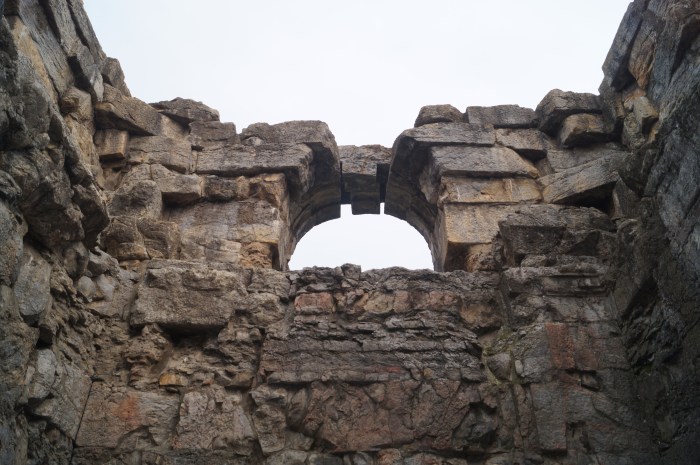
However, the most significant & magnificent of the temples that Lalitaditya built – the ruins of which even today stand out as the most striking of all the structures of the yore – was the temple dedicated to Sun God built by him at Martand. This place is in south Kashmir in the District of Anantnag. Today the temple is in total ruins. The central structure, the sanctum sanctorum stands tall, without a roof but majestic even in its destruction. It inspires awe. The structure is an embodiment of the talent of the architects & the artisans of Kashmir who absorbed the Gandharan, Greek, Chinese, Roman & Gupta architecture to build such a magnificent structure & bequeathed it to the future generations of Kashmiris.  The main temple is surrounded by colonnaded courtyard. It was also surrounded by 84 smaller shrines & gods from the Hindu pantheon are carved out & depicted on the walls & surrounding structure of the temple. Once you stand in the midst of the complex you cannot but just marvel at the dedication & the effort of the engineers & artisans who must have constructed this temple complex but also marvel at the phenomenon that must have resulted in its destruction.

While standing at such a lovely place I couldn’t but try to reflect at those opposing tendencies that result in building of a magnificent masterpiece & at the same time those equally forceful tendencies that desire to see the masterpiece destroyed & damned.

However, murmurs of the brutalized, desecrated & broken down structure are still loud & clear. They tell you a lot about the times of Lalitaditya & its magnificence. While I was walking through the colonnaded corridors I was mesmerized. Neither my tongue nor my pen could express what I was seeing. Its very difficult to find words for such colossus construction & at the same time find words for the colossus destruction. The beams & the columns still rest on each other – at some places normally & awkwardly at others. At many places the structure is ready to give way while at others the majestic strength is overpowering. There are several images of Hindu gods & goddesses carved on the temple walls that have survived the vagaries of nature & destruction.
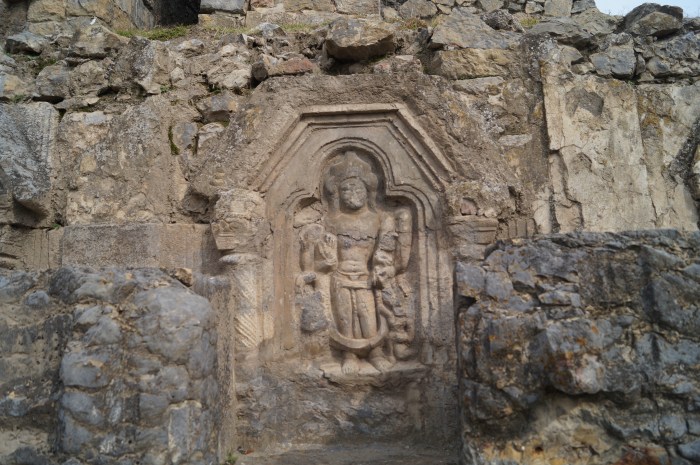
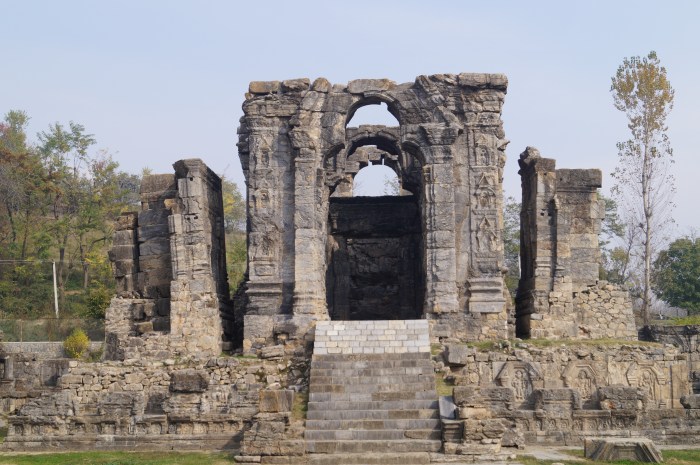
Martand Temple complex mesmerizes – that is all I can say.

Lalitaditya also diverted the waters of Vitasta (Jhelum) for irrigation of agricultural fields near Chakradhara where a string of water wheels were installed. Chakradhara is identified as Tsakdar plateau near Bijbihara. Chankunya’s wife also constructed a well the water of which was considered to have medicinal value.
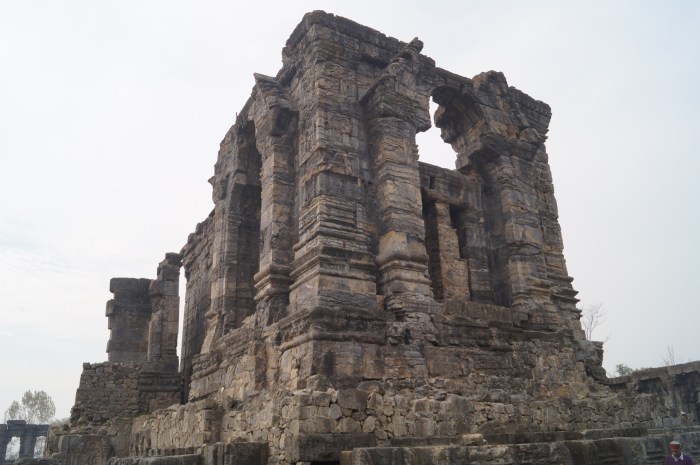
The construction activity under the king is an indication of the prosperity of the kingdom as well as the engineering acumen & artistic taste of the Kashmiri people of the time.

Lalitaditya couldn’t have continued to stay in Kashmir for long. He was ambitious, aspirational & enterprising. The north-western borders of India once again beckoned him. These areas have always been a bane to the political stability of the subcontinent as of Kashmir. He is believed to have moved in the direction of the Tarim Basin in the Xinjiang province of China crossing Talakaman & Gobi desert (Kalahans reference to sea of sand in Rajatarangani). After that no one heard anything about him. The ministers of Kashmir, worried as they were about the safety of the king, sent a messenger to find out his whereabouts. It is believed that the messenger did meet the king & returned to Kashmir with a set of instructions about governance of Kashmir as well as instructions regarding his successors.

Here I will quote from the verses of Kalahana in Rajatarangni about the message that the messenger brought from Lalitaditya to his ministers:

“What is this delusion on the part of men like you that you await my return after I have penetrated this region” (Taranga 4; verse 341)

“After giving up the acquisition of ever new triumphs day after day, what work do you see for me in my own realm if I should return”. (Taranga 4; verse 342)

“For rivers which have set out from their own region the ocean is the limit, but nowhere there is a limit for those who are frankly aspiring to be conquerors”. (Taranga 4; verse 343)

Thereafter the king gives a certain tips about the manner in which his kingdom must be administered so that there is no ‘mishap’ & no ‘blemish’ comes to the rulers. His instructions to his ministers come for an interesting reading;

  • He instructs his ministers that they should ensure that there is no dissension within the kingdom as the dissension breeds enemies inside who are more dangerous than the external enemies.
  • The dwellers in the depths of the mountains should not be allowed to get extra rich as with their riches they might take over the impregnable forts & cause difficulties for the central government.
  • It must be ensured that the villagers have crops just enough to sustain themselves for one season. Keeping this in mind the villagers shouldn’t even have bullocks more than their requirement. For if they have more they will become wealthier & more powerful. Thus they can become a cause of trouble for the king.

In addition to above he gives some more reasons which can enfeeble the kingdom which are enumerated below;

  • When the village population has the same facilities & possessions viz clothing, woollen blankets, food, jewelry, horses & dwellings as that of the citizens in the capital city there are chances that rebellion will brew.
  • The sure recipe for discontent is if taxes are exacted from only one District to maintain the army & other expenses of administration & are not evenly spread.
  • If proper vigil is not maintained at the passes & the fortifications are neglected because of arrogance of the king or because of lack of character of the officers there could be trouble for the kingdom.
  • When the civil servants form a league through matrimonial alliances with one another there could be trouble brewing for the kingdom.
  • When the king doesn’t apply his mind & complies with the suggestions & recommendations of his ministers, courtiers & his family members it must be understood that the kingdom is running out of luck.
  • Activities of royal princes should also be kept under a constant check as they could be another source of trouble.
  • Skill & intellect of the people should be understood before assigning them jobs in the kingdom.

He instructs the ministers that his younger son Vajraditya from his wife Chakramardika should not be made the king. However, he insists that if such a situation arises where his becoming king is necessitated his power should not be transgressed & he should always be protected.

Regarding the succession the king mentions that Kuvalyapida born out of Kamladevi should be made the king. However, he advises his ministers, that if he proves to be authoritative the ministers should not hesitate to overstep his authority. Under such conditions if the king gives up his kingship or consequently dies or commits suicide he should not be mourned.

The king had high opinion about his grandson Jaypida & instructed his ministers that in case he becomes the king he should be informed about the valour & governance of his grandfather so that he could emulate it.

Cankunya, thereafter called the assembly of the ministers & other subjects & announced the decisions of King Lalitaditya. His elder son, Kuvalyapida, ascended the throne of Kashmir. Thus, came to an end the tale of one of the greatest kings of Kashmir who left an indelible mark on the history of Kashmir. The greatest emblem of his period that shall always remind Kashmiris about the king Lalitaditya are the ruins of the majestic Martand Temple in Anantnag, Kashmir
Electricity – woes of Jammu province

The weather has become cold in Jammu transiting through a phase of being very pleasant. However, has the power position in Jammu improved? The answer is yes & no – both. Yes, if it doesn’t rain or get mildly windy; no, if it rains mildly, or gets mildly windy.

So there you are – if it is hot, electricity fails & if it is mildly rainy or windy it still fails. A few weeks back it took more than 24 hrs for restoration of electricity in several parts of Jammu area when it had failed after mild rain & equally mild windy conditions.

But this was not what Jammu Power Distribution Corporation said when the consumers complained of abysmally low voltages (80 volts & less against standard voltage of 220 volts), intermittent fluctuations/swings in the voltage & power breakdowns during the summer months at consumer end this year. They said that the situation will improve after temperatures come down & that it was bad only because of the “severe heat conditions in the ongoing summer season” which had “pushed the power demand up” resulting in “increased temperature of the power transformers beyond limits.” As if Jammu is the only place on earth where temperatures soar & thus power woes are naturally to be borne by the consumers.

A peep into the power infrastructure in Jammu is revealing. The malice is much deeper & encompasses transmission as well as distribution component of the power sector.

Infirm power distribution network:

When I started looking around out of curiosity, I came across very interesting real time data for 09.09.2020 at 21:26:51 Hrs that is tabulated below:

S. No.Name of Interstate FeederMegawatt (Import/Export)MVAR (Import/Export)
1.400KV Moga-Kishanpur feeder 1150(- )102
2.400KV Moga-Kishanpur feeder 2144(-)105
3.400KV Chamer2 – Kishanpur(-)43(-)33
4.400KV Jallandhar-Samba 115221
5.400KV Jallandhar-Samba 215420
6.220KV Sarna-Kishanpur 1113(-)15
7.220KV Sarna-Kishanpur 2113(-)13
8.220KV Sarna_Udhampur71(-)04
9.220KV Sarna-Hiranagar(-)178(-)83
 Total Import/Export675(-)314

Now what do these figures tell? They actually reveal a tale of technical infirmity of power system in Jammu region. The data suggests that J&K was exporting 675 megawatts of “real power” on its interstate transmission lines while it was importing 314 MVAR of “reactive power” at that moment. Since power system is a dynamic system as such this data can vary over time & also loading conditions of the network. This kind of situation arises in Jammu because of the air-conditioning load during summer months. What will make this data more interesting is that 314 MVAR of reactive power is almost the capacity of the 220/132 KV Burn substation in Megawatt terms; which effectively means that the capacity of almost Burn substation was being lost to technical infirmities in the power system network.

If an analogy is drawn with the human heart, the “active power” may be considered to be the good cholesterol & “reactive power” the bad cholesterol. Like the bad cholesterol impacts the heart of a human body adversely so does the “reactive power”. This component of power has an adverse impact on the “system voltage” of an electric supply network – be it transmission or distribution.

The question that can be asked is that isn’t the state electricity utility aware of what is required to be done to ameliorate this situation? The answer is yes – they know it.

It must be mentioned that Northern Region Power Committee (NRPC) / Technical Coordination Committee (TCC) which are the empowered committees under Central Electricity Authority (CEA) for coordination, planning & implementation of various projects & gives solution to technical issues that may arise during operation of the power systems in the Northern Region of the country mentions in Para B.3.4, B.3.7 & B.3.8 of the minutes of the meeting dated 14.07.2017 that the J&K PDD was requested to install 1102 MVAR capacity capacitor banks as per the “study carried out by Central Power Research Institute (CPRI).” J&KPDD was also informed in the meeting that this will be one step towards ameliorating the low voltage problem of the distribution network. It was also made clear to J&KPDD that the network would also require comprehensive system strengthening.

Well, what has been done till now?

It is understood that based on the recommendations of the NRPC/TCC/CPRI capacitor banks have been installed in around 10 of the 33 KV substations in Jammu region. However these capacitor banks are non-functional!! Whether the capacitor banks that have been installed have a capacity of 1102 MVAR; I am not very sure. In any case what is the use of these capacitor banks if they are non-operational?

Another very important issue that has come to light is that the transformers in the 33 KV sub stations, where the capacitor banks have been installed, don’t have parallel operation of the installed transformers. What good will it do to improve the “quality of power” if the capacitor banks have been installed but the transformers are not operated in parallel?

In any case the best practice the world over is to operate transformers in parallel (irrespective of whether capacitor banks are installed or not) in a substation for maximum efficiency, system redundancy & reliability. The question that why this practice is not followed in Jammu region, begs an answer. In Kashmir region this is a normal practice!

Strengthening transmission network in Rajouri/Poonch Districts:

In later part of 2011 I was assigned the task of completing the construction of the 400 KV Wagoora to Uri-2 Transmission line & Uri-1 to Uri-2 interconnector, by POWERGRID. During the construction of the line I & Mr. Kamal Sarkar from POWERGRID Corporate Center (who has now retired) were pained to see the abysmally low voltage at the consumer end in & around Uri. As it was winter the lamps dimly glowing because of low voltage were adding to the gloom caused by the cold weather. We thought it was outrageous as the residents of Uri & surrounding areas were not receiving quality power while the 720 MW capacity power projects located in their area were feeding “quality power” to the state / national grid. We also had experienced similar situation in Kishtwar where Dul Hasti project is located & was feeding 390 MW of power to the grid. In fact the power position in the erstwhile Doda District was found to be similar to what we saw in Uri. We raised the issue at appropriate levels in the state & central governments through POWERGRID (our parent organization which is also a Central Transmission Utility) which triggered a process of identifying solution to the problem. The J&KPDD had an important role to play at the NRPC/TCC forums as it was within their ambit to push for the new elements to be added into the power system of the state with POWERGRID extending a handholding in its capacity as a CTU. 

J&KPDD did push the issue & this resulted in strengthening of power transmission network for District Baramulla, of which Uri is a part. For this purpose a 400 KV Jallandhar – Samba – Amargarh (Baramulla) transmission line was got sanctioned from NRPC/TCC. The line was constructed & put into commercial operation on 01.01.2012.

The route for this line from Samba was approved to be passing through the Districts of Rajouri & Poonch with the understanding that a 400 KV substation would be constructed in any one of these two Districts based upon techno-economic survey. However, nothing to the effect has been done till date. The proposed substation in Rajouri/Poonch would not only have strengthened power transmission & distribution in these two Districts but also have relieved the already overloaded 220/132 KV Barn substation of J&K PDD from a part of the load being fed to Rajouri, Poonch on 132 KV lines thereby resulting in improved reliability in power supply position in areas such as Kot Balwal, Damana, Reasi, Akhnoor & Jourian etc.

Transmission to 220/132 KV Barn substation in turn could have been strengthened by providing a 220 KV link to the proposed 400/220 KV substation at Rajouri/Poonch thereby enhancing the reliability of power supply to consumers in Akhnoor, Jourian, Kot Balwal, Reasi & Poonch/Rajouri areas.

This part of the network has almost been forgotten.

Strengthening of Transmission network in erstwhile Doda District:

Looking at the transmission / distribution network of Jammu province one realizes that one of the worst placed are the Districts of Kishtwar & Doda. While two robust 400 KV Transmission lines wheel out power from the 390 MW Dulhasti Project to the Northern Grid but only one 132 KV transmission line of 1985/86 vintage wheels power back to this area from 220/132 KV Udhampur substation of J&KPDD for distribution to consumers. This line was constructed by NHPC to meet its power demand for construction of for Dulhasti power Project. In present times whenever this line breaks down because of snowfall during winter months or for any other reason the consumers in Kishtwar & adjoining areas are left without electricity for weeks on end. To be fair, the former minister & MLA of Inderwal, Mr GM Saroori; tried to get the system augmented so that the people of the area could be relieved of the hardships but nothing came out of it though he wrote & also met the then CM of the state Mr Omar Abdullah with a couple of technical proposals.

The way in which power sector has been neglected in erstwhile Doda District can be seen from the fact that the 132 KV line from Ramban to Khelani has almost been forgotten by J&KPDD though construction of it was started around 12 years back.

What is more startling is that transmission system approved by NRPC/TCC (minutes of meeting dated 20.11.2020) for evacuation of power from the upcoming hydropower projects viz Pakaldul (1000 MW), Kiru (624 MW) & Kwar (540 MW) doesn’t have any provision for wheeling power on the presently available 132 KV level network to the erstwhile Doda District. The proposed Transmission Line network on the website of J&KPDD (updated on 07.09.2020) doesn’t have any provision for strengthening of transmission line network of Kishtwar / erstwhile Doda District either.

Another forgotten transmission line is 220 KV line from Udhampur to Gladni. Construction of this line was started around 10 years back.

These forgotten lines (on which lot of money has already been spent) could have strengthened the transmission network & provided alternate path for power supply to respective substations for betterment of power supply at consumers end.

Renewable energy:

Throughout the country there has been a thrust for installation of renewable energy. Under National Solar Mission a 100 MW solar power plant was approved to be installed at Kathua in Jammu province in 2015 along with several other solar parks across the country. While the installed capacity of solar power in the country has risen to 36,300 MW by the end of October 2020, J&K has not been able to begin work on a power plant that shall generate a meager 100 MW!! What could be more distressing a situation than this for J&K!!

There is no visible movement in the direction of installing roof based solar power plants either.

In addition to above the possibility of installing solar power plants along the canals in Jammu could also be explored. If Gujarat & several other states can adopt this method of power generation why can’t Jammu?

The country also has an installed capacity of more than 10,000 MW of “Bio-mass/waste to energy” power but J&K has not even started thinking on these lines. Additionally, the country also has an installed capacity of around 38,000 MW of wind power but J&K has not explored the possibility of installing wind power generating plants. In my opinion Shaitani Nallh & several areas in Kishtwar have good potential for wind power generation in Jammu region.

Availability of real time data for power system operation & control:

Around 2012/13 J&KPDD started execution of a state of the art project that entailed installation of optical fiber cable (OPGW) over its transmission lines & corresponding communication equipment at several substations. The project was funded through Prime Minister’s package. The idea was to get real time data from various substations for efficient & real time operation of the state grid. The spare bandwidth available with J&KPDD was slated to be leased out to communication companies / network providers thus bringing in revenue for the department as well.

From the minutes of meeting issued by NRPC dated 20.11.2020 it is understood that data is not available from any of the substations to NRLDC for efficient load dispatch. If it is not available to NRLDC it will surely not be available to state load dispatch centre either. It is also understood that whatever data is available to NRLDC is from central sector network nodes.

It is amazing especially as more than Rs. 50 crores is believed to have already been spent on this very important project but the project has not been taken to its logical conclusion. This project, if faithfully implemented, would have made real time data of various power network nodes & elements of UT of J&K available to the concerned engineers, managers & administrators to take appropriate decisions in real time situation. This would certainly have brought in transparency & efficiency in the system.

Conclusion:

The problems that the consumers face with respect to availability of “quality power” in the Jammu region, is not going to go away very soon as enumerated in the facts above. Situation in summers next year or year thereafter is not going to change much either excepting in some selected areas that carry a VIP tag.

Mild rains & winds will continue to cause breakdown of electricity without fail unless drastic & immediate steps are taken to stem the rot. Distribution strengthening works are certainly going on in several areas but will they be able to improve the situation & at what speed is anybody’s guess!!

Engineers in Jammu will have to show technical stewardship – I am emphasizing this with full responsibility – or else the situation will not improve. This is no pontification.

A walk through Jammu will reveal that even elementary routine maintenance & precautions are not taken by the power utilities. 33 KV, 11 KV, 415 volt power lines are seen to be passing through the foliage & trees almost everywhere. With these conditions, engineers cannot expect a miracle. Tripping or breakdown free system, especially if it rains or there are mild windy conditions cannot be expected under these conditions. Isn’t branch-cutting / pruning of trees one of the elementary requirements to prevent tripping of power lines as they get earthed through “moist” trees & foliage? Such a situation can also endanger lives of humans & cattle that may come in contact with trees during power system fault conditions.

At the same time we should not forget importance of healthy & well graded system protection, so essential for an efficient power network? J&KPDD used to have “Load Dispatch Metering & Testing Division” the task of which was also to periodically test the protection system & provide relay settings & configure them. With substantial expansion of the power system network in the UT of J&K the Division should have been upgraded & more competent staff should have been earmarked for it, but I am given to understand that testing / configuration / grading of protection etc is not considered to be a priority.

As such it needs to be emphasized that there are so many lose ends to be tied in Jammu province as far as electric power network is concerned before it can be ensured that a flawless & efficient power system for the consumers is available. Jammu has to travel a very long way in that direction.    

Supplication to Goddess for forgiveness

(An attempted translation of Shri Shankracharya’s Devi Khesyamapan stotram)

Neither I know recitation, nor do I possess any instruments of worship; I am unaware of any practices of singing praises to You,

Neither I know how to beseech You, nor I know how to attract Your attention; I am unaware of any procedures of singing ode to You.

I don’t even know how to dance to please You or cry for Your attention,

But I have only one understanding for sure; that is to follow You, as it is the only path that can reduce my hardships. (1.0)

I am the one without knowledge, I have no resources and am lazy too,

Nor am I able to pray to You with devotion, fervor or attention.

But then You are the only One who can bring me out of this misery of my own making, O Mother,

For I know that even if a worthless son is born to a Mother; the Mother always continues to be Motherly to him; She is always blemish-less & always full of love. (2.0)

O Mother, there are innumerable simpleton sons of Yours roaming this earth,

But from amongst them all I am the simplest one & I am alike to one of Your Own sons.

O Goddess it is not appropriate of You to forsake me,

For I know that even if a worthless son is born to a Mother; the Mother always continues to be Motherly to him; She is always blemish-less & always full of love. (3.0)

O Goddess, I have never been able to serve You,

Nor have I been able to raise resources for Your worship.

Yet You still shower Your love, blessings & affection on such a worthless son,

For I know that even if a worthless son is born to a Mother; the Mother always continues to be Motherly to him; She is always blemish-less & always full of love. (4.0)

I worshiped all other beings throughout my life in different ways,

At this age it has become impossible for me to carry out their worship & I don’t expect any help from them either.

However, O Mother of God Ganesha, where should I go now

If you don’t bestow Your Benevolence on me now (5.0)

O Mother Goddess, a word of prayer to You – when listened carefully – is like nectar to the ears of the listener

The one who assimilates it, feels as if he has received all the gifts of the world. He lives in the world fearlessly thereafter.

If this is the impact of one word of the prayer, then what would I contemplate about the human beings,

Who have devoted all their lives in Your service? (6.0)

Here we have One, who smears His body with ashes from the cremation ground, does not care about His clothing & has poison permanently ensconced in His throat,

He has a lock of unkempt hair on His head, serpents around His neck & is famous as the” Lord of the animal world”.

He wears a garland of human skulls & is always in the company of imps & ghostly beings,

He too attained the status of the “Lord of the Universe” only after His union with You. (7.0)

O Mother, I don’t seek salvation nor the splendor of this world,

O Goddess, the One whose face shines alike to the moon, I don’t seek scientific comforts of this world.

I only seek Your blessings so that I spend rest of my life reciting Your name; Rudrani-Rudrani & Shiv-Shiv-Bhawani (8.0)

O Goddess, I have never been able to pray to You in a formal way,

I have always been loud & unbearable to many in my life.

Still You – on Your Own – maintain a kind oversight over me,

It is only You – the Graceful One – Who can take, a worthless son like me, under Your Benevolent Protection. (9.0)

I remember, memorize & worship Your Name, O Goddess Durga

Please take me under Your protection.

I am worshiping You now as I have been overtaken by difficult circumstances,

Kindly don’t consider this to be my foolhardiness or selfishness. (10.0)

O Mother, I am sure You are continuing to be kind & benevolent to me,

For which I am not surprised either.

For I know for sure that a Mother doesn’t ever forsake even a single of Her worthless sons – never. (11.0)

O Goddess, I admit that I am the most worthless son of yours on this earth; but I know You are the Greatest Forgiver if I chose the right path even now – at this age.

In view of above kindly consider my supplication, with my request to treat it in whatever way You think is appropriate for a person like me. (12.0)

(Thus, comes to an end the Devi Khesyamapan stotram written by Shri Shankracharya)

Devi Apradhkheymapan Storam was written by Shri Shankracharya.

This is an attempt to translate it into English – this Navratri – for modern youth who find it difficult to read Sanskrit. I am no expert in Sanskrit either but have tried to translate it to the best of my understanding, ability & knowledge. In the process I have also taken some liberties – liberties of a translator.

Suggestions to improve on it – I am sure there will be many, many & many – are welcome.

“90 V or less” is a voltage too!! – thus believes Jammu Power Distribution Corporation

The other day “Twitter” was abuzz with complaints from several places/localities in Jammu province that the electric voltage at the consumer end was continuously fluctuating & at several places it was 90 volts as against the standard 220 volts.

One of the consumers, Shubham Dogra (@Shubham_7778), was persistently following it up with the senior officers of the Jammu Power Distribution Corporation. After 12 days he received a reply from the power distribution utility which is reproduced herein:

“Due to severe heat in the ongoing summer season, the power demand of the UT of J&K has increased & the temperature of the Power Transformers is rising beyond limits. To prevent permanent damage to the power transformers at Receiving/Grid Stations, load shedding has to be imposed in most of the areas of Jammu province, including metered areas, during peak load hours. These days, a large number of complaints regarding “severe voltage fluctuations” are continuously pouring in from Jammu & its adjoining areas. To overcome this, voltage has been stepped up from the power transformers in Receiving / Grid stations, to some extent. However, the consumers are also requested to curtail their consumption, as far as possible. JPDCL is always ready to serve all its esteemed consumers satisfactorily with their support, by reducing their electricity consumption till the prevailing phase of hot summers is passed”.

This reply took me by surprise & carried me back, as in a time machine, to 1978 when I joined power Development Department, after graduating from REC Srinagar (now NIT) & was posted to Bemina Grid Station. Bemina Grid station those days was the main Load Dispatch Center for the Kashmir province. Its responsibility included coordination with the Load Dispatch Centre at Jammu. There was only one 132 KV Double Circuit Transmission line between Udhampur & Bemina Grid Station (near Srinagar) of PDD that connected the Valley to the Northern Grid. Udhampur Grid Station was of course connected to Sarna Sub Station in Punjab & thus to Northern Grid. The 132 KV Udhampur – Bemina Transmission line was the “anchor” that ensured that the system frequency in the Valley remained stable & voltage too would continue to stay in a “respectable” range at 132 KV level.

The 132 KV Transmission Line was very unstable especially during the winter months when the Peer Panjal mountains, over which the line passed, would get snowed down resulting invariably to damage to the line. In summers too high-speed winds & thunderstorms over the mountain range would cause break down of the line but this was infrequent. Thus summers were remarkably good for power system stability but the winter months were an absolute challenge. Those days the hydel power houses operating in the Valley were Lower Jehlum, Ganderbal & Sumbal. During the summers they would operate at full installed capacity viz 105, 14 & 20 Megawatts respectively but during winter their generation would drop down to one third of their installed capacity in view of reduction in the water flow in the rivers on which these were constructed thus upsetting the electricity demand / supply equilibrium. Ganderbal Powerhouse had the “unique capability” of operating at as low a frequency as 45 Hz as its protection system was “outrageously” so configured. Thus, the efficiency of the shift staff at the Bemina Grid Station was measured by the speed at which they would rush to put off maximum load by switching off 33 KV lines emanating from Bemina in case of failure of 132 KV Udhampur – Bemina Transmission Line so that Ganderbal powerhouse could be saved from a complete shutdown & power could be fed to the essential services like hospitals & VIP areas. The tripping of 132 KV line would invariably trip the Lower Jehlum & Sumbal powerhouses as their protection system was configured as per the ‘best practices’ in vogue as operating at low frequency also results in unwanted wear & tear of the machines. Total electric load of the Valley as that of Jammu wasn’t much those days as compared to what it is now. Total power demand of the Valley those days must have been around 150 MW.

Till the time 132 KV line would come back after a ‘break down’ or if we were lucky to synchronize lower Jehlum power house with Ganderbal power house manually (communication was awfully poor) the Valley would be operating at a frequency between 45 & 52/53 Hz & the minimum voltage at the consumer end could be anything like 40 Volts. The idea was to keep the incandescent lamp aglow so that the consumers would get the satisfaction of seeing the dim orange glow of filament of the bulb.

Over the years power generation & transmission system of J&K has been improved/strengthened. There are two 400 KV Double Circuit Transmission Lines (Kishenpur – New Wanpoh of POWERGRID) passing over Peer Panjal connecting the Valley to the Northern Grid & an additional 400 KV line from Jallandhar to Samba & Amargarh along the Mughal road. Jammu is also connected to the Northern Grid via Kishanpur & Samba substations with the construction of several interstate transmission lines. Many sub stations in central sector (Wagoora, New Wanpoh, Kishanpur & Samba owned by POWERGRID) & state sector have also come up. Hydel generating stations have also come up in Jammu & Kashmir provinces under both the sectors. Additionally, there is no shortage of power supply in the country & its transmission has been further made easy by establishment of one electric grid for the entire nation so that power can flow by displacement method from generator to consumer from any part of the country.

Therefore, it is a pain to see that after 42 years of infrastructural development in power sector the consumer is still stuck in the “LOW/FLUCTUATING VOLTAGE SYNDROME” in several parts of Jammu province. Same must be true of Kashmir province as well. This in effect means that there is something seriously wrong in the way distribution network has been planned & implemented in J&K in general & Jammu in particular. What could be the reason that after augmentation of power infrastructure at generation & transmission level the available voltage at consumer end still continues to be 90 Volts (many a times less than 90V too) against the technically specified requirement of 220 volts? Added to this is the menace of regular voltage fluctuation.

Notwithstanding the contention of JPDC as communicated to Mr. Shubham Dogra it is the responsibility of the distribution utility to ensure that technically specified voltage is available at the consumers end. Consumer has a right to have “quality power” at his/her premises. That is what he/she pays his/her electricity fee for. The fee is for “quality power”.

Today we cannot afford to have substandard, fluctuating/low voltage power supply as it can damage electronic & other electrical gadgets of consumers. How will the gadgets / equipment used for communication network of “Digital India”, for example, be able to sustain the fluctuating / abysmally low voltages?

Power problem has been impacting water supply in several areas too.

Under the circumstances will the Government’s flagship programme like “Digital India” & “Jal Jeevan Mission” succeed?

The contention of JPDC that the present distress in power supply is because of hot weather is nothing but superfluous. Is Jammu the only place in the country or the world where temperatures rise during the summer months? Does it mean that all those places or countries that have warm sub-tropical climate akin to that of Jammu have fluctuating / low voltage phenomenon & the consumers in these places are destined to live with “substandard electricity”? Transformers & associated electric equipment are designed to withstand warm sub-tropical climatic conditions.

As a part of regular consultations & planning / implementation a meeting of Northern Region Power Committee (NRPC) / Technical Coordination Committee (TCC) was held on 02.05.2017 in which engineers from J&K PDD also participated. The minutes of the meeting were issued on 14.07.2017. This is the period during which Northern Region Power Committee was requesting & also encouraging state power utilities to install capacitor banks at their electrical installations for improvement of power factor enabling improvement of system voltage.

J&KPDD was requested to install 1102 MVAR capacity capacitor banks as per the “study carried out by Central Power Research Institute”.   J&KPDD was also informed in the said meeting that this may be one step towards ameliorating the low voltage problem of the distribution network in J&K but what is required is comprehensive “system strengthening”. (Para B.3.4, B.3.7, B.3.8).

To put things straight; it is only through faithful system study & faithful strengthening of the electricity distribution network in consonance with the system study report that the problem of low voltage in Jammu can be bid a good-bye. If the Distribution Utility doesn’t take steps in the right direction today then the consumer shall be facing the same problem of “substandard electricity” next year & then the year thereafter & finally the decade after.

It may be noted that it is we, the organization & also the society, that are responsible for sub standard and fluctuating electricity; though the responsibility stays 80% with the Distribution Utility as it has to create infrastructure & 20% with those who use it. It wasn’t exactly a great sight to see JPDC disconnecting several illegal power connections in such well-to-do areas of Jammu as Gandhi Nagar, Channi Himmat, Sainik Colony & Shastri Nagar a few weeks back.

It does not speak well of the society that is consuming electricity & not paying for it. If the influential & the rich of the society will not pay for the electricity consumed then who will?

Another important problem with electric supply is that it fails in the face of a mild windy condition. Should this situation be considered “NORMAL”?

Thus JPDC shall have to put its act together now so that consumers are fed “quality power” the next year & probably in phases!! If the planning & execution doesn’t start today then, I am afraid, the power position in Jammu will not improve for many more years to come.

Message from Dr. R.P. Singh, Retired CMD, POWERGRID – putting at rest rumours & speculations regarding stability of Indian Power Grid during the planned switching off of lights at 9 pm, for 9 minutes, today in view of appeal by the Honorable Prime Minister of India

Honourable Prime Minister of India has asked people of this great country of ours , India, to switch off their domestic lights only & come out on verandas or roof tops of their flats, houses, dwellings – while maintaining social distancing.

It is needless to emphasise that he has urged upon us to demonstrate our solidarity by demonstrating our determination, commitment & courage to defeat CORONA virus.

Togetherness & unity of the Nation, in this endeavour, will be effectively visible in the night when we light up multiple lamps, candles or put on the flashlights of our mobile phones as a symbol of our determination to fight the darkness represented by the corona virus.

Multiple rumours & questions being asked about whether the Electric Grid will face similar problems as happened on two consecutive days on 30th & 31st of July 2012 have only one answer & that is an emphatic “NO”. This is because of the fact that a lot of augmentation has taken place in our well planned & networked T&D systems with latest “Four Hierarchical Load Dispatch Centers” which have their own dedicated communication system, at local, States, Regional & National levels, backed with stringent ‘Regulatory Guide Lines” implemented after July 2012 Grid Failures.

After announcement of “National Lock-down” in wake of corona pandemic the peak power demand in the country has come down from 170 Gigawatts to 125 Gigawatts thus forcing to take out more than 250 trunk transmission lines of 400 KV and above. The switching off of domestic lights may bring down the power demand by another 10 to 12 Gigawatts ie 10% of the current demand. This is not a big deal. It can be managed by using our hydro & gas fired power plants which can be backed out or connected to power grid instantly. A pertinent example is a car where we accelerate or decelerate it as per the need of the moment.

To conclude we must appreciate those years of electric grid operations when we had radial T&D systems & dispersed sources of generation & load centres working under a grid frequency regime of 48.5 Hz & 51.5 Hz with obsolete load management systems. Today’s Grid Frequency regime is 49.95 Hz to 50.05 Hz akin to world standards with enough generation at load centres backed with Hydro & Gas plants.

Have faith in “Power Fraternity”

Dr. R.P.Singh

Retired Chairman cum Managing Director,

POWERGRID

Leaderless Jammu at a crucial time in history

05.08.2019 will go down in history as a day of unexpected & unusual changes with far-reaching consequences for the people of Jammu, Kashmir & Ladakh as well as for the rest of India. While Ladakh became a Union Territory of its own – separated from the State of J&K – Jammu & Kashmir came to be designated as another Union Territory. The change was affected using article 370 of the Indian Constitution & abrogating the special – but temporary – status accorded to the state of Jammu & Kashmir.

After 7 months of the resolution being passed by the Indian Parliament & notified in the Gazette of India the process of implementing the provisions of the act in the Union Territory of Jammu & Kashmir is under progress.

Politics:

Initially the political class of the Kashmir Valley was shaken beyond belief because of the shock & awe technique used by the Central Government in Parliament as well as on the ground. Even today three Ex Chief Ministers of J&K state along with some of their workers are under detention. However, over a period of time, the Kashmir based politicians have put their act together & some of them have come together to launch a new political party today which the President of the party described as a Regional party with National outlook.  The party is essentially an amalgam of dissenters from several parties that were in operation in the erstwhile state of Jammu & Kashmir.

The President of the party broadly described the objectives of the party which include restoration of statehood to Jammu & Kashmir, domicile rights to the people of Jammu & Kashmir especially in context of land & jobs. On abrogation of article 370 & 35A he said that since the matter is pending before the Supreme Court he would not like to comment on it.

He said that his template for Jammu & Kashmir would be development of the state, truth & only truth as well as harmony & peace for the people of the Union Territory.

In fact this is a new party on the ground but the old political & non-political entities continue to be active & on the face of it it looks like that the Kashmir based politicians have taken a lead once again leaving the so called politicians of Jammu in the background & playing second (third…fourth…..may be n ‘th’) fiddle.

Where does Jammu region stand under the changed circumstances?

Since 1930s it is Kashmir that has dominated the narrative of Jammu & Kashmir – both nationally & internationally. Prior to 1947 it was the cozy relationship between Jawaharlal Nehru & the Kashmiri leader Sheikh Mohammad Abdullah that swept the Dogra dynasty away from the helm of affairs of the erstwhile princely state.

Subsequent to independence (bifurcation) of the country the relationship between the Kashmiri leader & Jawaharlal Nehru deteriorated & the Sheikh was arrested on 08.08.1953 for anti-national activities. In Jammu the Praja Parishad tried to put up a valiant fight for the rights of the people from the Jammu region but events overtook them (during this period Dr. Shyama Prasad Mukherjee, founder president of Jana Sangh died on 23.06.1953, under suspicious circumstances, in Srinagar) culminating in political power staying & getting further consolidated in the hands of the Kashmiri political leadership.  Jammu & Ladakh continued to stay on the side lines, rudderless & leaderless with spikes of short & fewer in between bursts of anger at the plight of its people.

Kashmir too had its problems but their nature was entirely different from that of the people of Jammu & Ladakh. They wanted to stay separate from the Indian nation while maintaining a tenuous “love-HATE” relationship which was developed into an art form for extracting there pound of flesh & extravagant concessions from the ever ready Central Government that always was also ready to leave the contentious issues to be settled for some other day or preferably by some other Government. These attitudes on both the sides culminated in the beginning of an atrocious era of mayhem from 1989/90 the end to which is not yet in sight.

The Central Government under Prime Minister Modi thought that they need to do something different after all their efforts to normalize situation in the Kashmir Valley came to a naught. Article 370 of the Indian Constitution was used to abrogate special status to the J&K state on 05.08.2019 that was one of the main demands of the Praja Parishad. With this curtains also came down on controversial article 35A.

But is abrogation of article 370 an end in itself? Not really. The reason being that because of 70 years of (mis)rule by the Kashmiri political class (three families specifically) over Jammu & Kashmir the trust between the two regions is at its lowest ebb. It has always been felt by the people of Jammu & Ladakh (now a separate UT) that their regions were always given a step motherly treatment be it in the field of infrastructure development, education or employment. It is not often realized that the only Chief Minister of Jammu & Kashmir from Jammu region – Ghulam Nabi Azad – fell to the mechanizations of Kashmiri leadership & could not complete his tenure as Chief Minister of the state.

What is actually required is the political, economic & administrative empowerment of Jammu region through legally enabled structural arrangements & guarantees so that any new political dispensation that may come to rule J&K after elections are called is not able to hijack the resources of the state as per its whims & fancies. Some of the actions required are as under:

  1. Delimitation of constituencies: Delimitation of electoral constituencies should be done in a fair & transparent manner. Delimitation should be based on a fresh census of the Union Territory & not on the census carried out in 2011. The census of 2011 is believed to be highly flawed. Delimitation based on flawed census will have the same impact on the psyche of the people of the State as was experienced during the rigged state elections of 1987 with unpredictable consequences. A fair & transparent process will satisfy every stake holder & no one will have a grudge against anyone even if one region gets higher number of seats to legislature than the other.
  2. Regional Development Councils: Regional Development Councils should be constituted for both the regions of Jammu & Kashmir with adequate political, financial & administrative powers to ensure economic & cultural development of both the regions.
  3. CM & DyCM: If the CM is from one region the DyCM should be from other region of the UT.
  4. Ministers & their portfolios: Proportional representation should be given to both the regions while appointing Ministers & all important portfolios should not go to Ministers from one region.
  5. Budget: There should be separate budget for development works of both the regions & diversion of funds from one region to another should not be allowed. Watch bodies need to be established to ensure that the infrastructure projects do not incur time & cost overruns. There should be a well publicized works & procurement policy of the Government for the projects along with a clear cut delegation of powers for the engineers / managers of the projects.
  6. Employment: Number of employees in the Government service including the Civil Secretariat should be proportionate to the population of the regions.
  7. Durbar Move: There is no reason for all the offices to move from Jammu to Srinagar & vice versa especially in the modern age of communication & video conferencing. Judiciously selected offices should only move from one place to another keeping the historicity of the custom in view. Kashmir experiences difficulties during winter months & there is no logical reason for all the Ministers from the Valley to be in Jammu during winter months when they are required more in the Valley to stay alongside their people. Similarly there doesn’t seem to be any reason for Ministers from Jammu region to be in Kashmir during summer months when they could make a difference to the lives of the people in Jammu by staying alongside them.
  8. Reversion back to statehood: This is a very tricky issue. We should ask the concerned powers as to why a full-fledged state was converted to a Union Territory? My understanding is that this unusual action was taken to ensure an enabling hand to the Central Government to rid the State of anomalies that they might have observed during their sharing of power with the PDP. Have those anomalies been rectified? In my opinion – once again – they have not been. As such the question of reversion of UT to Statehood should only come when the points mentioned above are completely addressed.

Having deliberated upon some of the issues mentioned above my mind goes back to the same basic question. While the political leadership of Kashmir has once again found its feet & are utilizing their resources, acumen, understanding, knowledge & putting in concerted efforts to move the political events in a direction that will eventually put them in a pole position in the politics of Jammu & Kashmir the so called political leadership of Jammu is confused & working at cross purposes.

This is a very important & crucial time in the history of Jammu & Kashmir. This time has the same importance as the time when Maharaja Hari Singh signed the “instrument of accession” dovetailing the fate of Jammu & Kashmir with that of India. It is time that the leadership of Jammu – all across the political spectrum – puts its head together & starts thinking about the place geographical Jammu & its people should have in immediate future. They must try to figure out what is good for the people of Jammu region & formulate a plan of action to ensure a life of respect & political, administrative & economic empowerment. The window of opportunity is not going to remain open for long. In fact it is already too late & Jammuites must put their act together so that the people of both the regions – Jammu & Kashmir – are able to lead a life of equality, progress, peace & tranquility.

PS: I draw a very clear distinction between the Kashmiri political class & the common Kashmiris. It is my belief based on my experience that the common Kashmiris are wonderful people. The same cannot be said of the political leadership.


Dr. Karan Singh: the original votary of devolution of powers between the provinces of Jammu & Kashmir (Looking beyond abrogation of the temporary Article 370/35A)

As on date Articles 370 & 35A of the Indian Constitution are politically “dusted & done away with” though legal challenges remain as there are several cases with regard to the decision of the Central Government pending in the Supreme Court of India.

Dr. Karan Singh’s speaking on Maharaja Gulab Singh’s 227th birth anniversary:

While speaking on the 227th birth anniversary of Maharaja Gulab Singh on 21st October 2019, Dr. Karan Singh spoke at length about the present political situation of J&K. He said that while there is a need to open a dialogue with the representatives of recognized political parties & civil society in Kashmir it is important to ensure a fair distribution of economic, administrative & political powers between the two regions (Jammu & Kashmir).

He also mentioned that he will not be able to speak on the legal matters as they are pending in the Supreme Court but since a political decision has been taken as such one should approach it with a positive mindset & move ahead.

J&K’s integration with India & regional autonomy for the provinces:

Dr. Karan Singh has the distinction of having joined the political milieu of J&K as its Regent after Maharaja Hari Singh & Maharani were exiled from J&K through the mechanizations of Sheikh Mohammad Abdullah & full support of Jawaharlal Nehru. He has been a witness to the tumults period of partition of the country & attack by the Pakistan forces under the guise of tribal invasion & the situation that unfolded thereafter. He had to deal with the colossuses like Jawaharlal Nehru, Sardar Patel & Sheikh Abdullah (who had a blatant anti-Dogra political ideology). That he was able to withstand those times & the pressures therein & still stay unblemished is a tribute to his acumen, astute foresight & understanding of the unfolding events.

In-spite of the everchanging political situation in the country Dr. Karan Singh always stood for greater integration of J&K with the mainland India. Coupled to this he has been a votary of Regional Autonomy for the three regions of the state viz Jammu, Kashmir & Ladakh.

In fact, Dr. Karan Singh was reiterating the same position at the function at Jammu on 21.10.2019 that he had been raising with Jawaharlal Nehru & Indira Gandhi regarding regional autonomy to the provinces of Jammu & Kashmir.

As early as 24.09.1952, after a trip to Ladakh, Dr. Karan Singh wrote to Jawaharlal Nehru that the people of Ladakh led by KushakBakula “were genuinely & fervently desirous of having the closest possible union with India….As a matter of fact they were pressing that India should directly take over the administration of Ladakh”. Though Dr. Karan Singh told them that it was not possible at that particular moment in time because of the prevailing national & international situation but he did write about the desire of the people of Ladakh to Nehru.

Finally, the desire of Kushak Bakula& the people of Ladakh was fulfilled on 05.08.2019, after a gap of 67 years.

Dr. Karan Singh was fully aware that while Jammuites & Ladakhis desired complete integration of the State with the Union of India, the Kashmiri political leadership (as distinct from the common Kashmiris – who truly represent all the dimensions of Kashmiriyat ) wanted a “limited nature of accession & not complete integration”. Meanwhile, Praja Parishad, a political entity of Jammu, was spearheading an agitation against conditional integration of J&K to India which found a lot of traction with the people of Jammu. Their demands ranged from flying the National Flag of India on the official buildings in J&K (which was regularly turned down by the Sheikh Government) to extending the constitution of India to the state. They also questioned the treatment meted out to Maharaja Hari Singh, a nationalist, as compared to the position accorded to the Nizam of Hyderabad in-spite of the fact that his Razakars had fought an armed war against Indian army.

Their slogan “Ek Nishan; Ek Vidhan; Ek Pradhan (one flag; one constitution & one President) became their cry during the struggle. The agitation worried Dr. Karan Singh. He wanted the Sheikh & the Central Government to meet the representatives of the agitating leaders, but Sheikh Abdullah was adamant that he would not meet the ‘reactionary & communal’ people. Jawaharlal did meet Pt. Prem Nath Dogra (the leader of Praja Parishad) once but the meeting  did not go very well & after that Nehru was not inclined to meet the leaders of Praja Parishad. Matters got complicated further as Praja Parisahd, finding no takers of their point of view either in J&K or the Central Government turned to Jan Sangh for support.

In a letter addressed to Jawaharlal Nehru on 22.12.1952 Dr. Karan Singh writes:

“With particular reference to Jammu problem (Praja Parishad agitation), very close attention must be paid to framing this Constitution (J&K Constitution) in a manner in which all sections of the State feel secure that their culture, rights, & interests are fully safeguarded, & that there is absolutely no chance for the exploitation of one area of people by another. This is the clearly expressed & oft-repeated intention of Sheikh Sahib & must be practically put into effect by working out a satisfactory system of provincial autonomy”.

An agreement had been reached between the Sheikh & the Govt of India on 24.07.1952 in which broader understanding was reached about the special relationship of the J&K State with that of Indian Union. This agreement was supposed to get reflected in a separate constitution of the J&K State.The Sheikh got proposals like abolition of hereditary rulership, land reforms & a new flag for the state approved from the State Constituent Assembly first & started dragging feet on the others. The intentions of the Sheikh came under cloud especially after he met members of US administration & started speaking in public & private about the option of independence for the State.

Consequently, Sheikh Abdullah was dismissed from the Prime Minister-ship of J&K & arrested on 08/09.08.1953.

In another letter dated 04.01.1953 to Nehru, Dr. Karan Singh again stresses the need for provincial autonomy to ameliorate the strained relations between the provinces. He mentions that though the agitation in Jammu has been going on for more than one & a half months, but the State Govt. has not taken any “positive or concrete” steps to generate confidence in the people. He further mentions that the first step should be to implement “the remaining provisions of the Indo-Kashmir Agreement & reducing them as soon as possible to constitutional form, & secondly, the granting & working out of a system of provincial autonomy”. Dr. Karan Singh also suggests that Nehru should use his influence with the Sheikh when he meets him in Hyderabad during 58th session of Indian National Congress (the Sheikh was invited to this meet) & persuade him to “implement the Delhi agreement fully” & also make him “agree in principle to provincial autonomy for Jammu province”.

In another letter dated 23.02.1953 Dr. Karan Singh again reiterates to Nehru that “a committee consisting mostly of people Jammu, should be set up to study & work out a system of provincial autonomy for Jammu”. He says that the committee could submit their report within two months & this report should be “put before the Assembly &should become the basis of clauses regarding provincial autonomy in the Constitution”.

Time & again Dr. Karan Singh took up this matter with Nehru, but nothing really came out of it. It is possible that Nehru was never able to broach the matter with the Sheikh in right earnest as he was afraid of annoying him. Dr. Karan Singh, in a record of talks with Jawaharlal Nehru dated 21.04.1953 writes that “regarding the political deadlock, it does not seem that he will do anything at all about bringing about a settlement. He stressed that the whole international case rested upon Sheikh Abdullah”.Dr. Karan Singh further confesses in the same note that “I failed to find any considerable keenness or sense of urgency (in Nehru) in bringing this to a close. He seemed to be leaving all to Sheikh Abdullah”.

In a fast-changing political scenario the constitution of J&K was adopted by the constituent assembly on 17.11.1956 & it came into force on 26.01.1957.The idea of provincial autonomy, for which Dr. Karan Singh was regularly pursuing with Nehru in particular & Union Government in general was completely eclipsed. It is worth noting that the proclamation for Constituent Assembly was signed by Dr. Singh on 21.04.1951 but because of the intransient attitude of the Sheikh it took so many years to pass though the broader guidelines were frozen in the Delhi declaration of 24.07.1952.

Dr. Karan Singh’s letter to Indira Gandhi on provincial autonomy:

Dr. Karan Singh’s took up the issue of provincial autonomy once again with Indira Gandhi vide letter dated 10.07.1967 in which he clearly states that “the present political structure of the state does not fulfil the genuine & democratic aspirations of the people of the people of its 3 regions – Kashmir, Jammu & Ladakh. One of the approaches could be to proceed with linguistic reorganization of the State, as has been done elsewhere in India. As this presented certain difficulties, it was suggested that a solution within the framework of the present State should be considered”.

Dr. Karan Singh was, in fact desirous of granting autonomy to all the 3 Regions of the state but he was taken aback because of a press conference on 26.06.1967 in Srinagar by Mr. Ghulam Mohammad Sadiq (Chief Minister of J&K) expressing that “…the idea of regional autonomy is completely against the interest of the State. It is rather a mischievous move”.

Dr. Karan Singh also mentioned in his letter that the State Government through its Field Survey Organization was trying to “completely distort the whole idea of regional autonomy & arouse caste & communal prejudices against it”.

Hence, it can very safely be concluded that the Kashmiri political class, of whichever political grouping or ideological dispensation was not interested in resolution of regional disparities even within the framework of the State constitution.

In the note attached to the letter dated 10.07.1967 titled “Regional Autonomy in Jammu & Kashmir” Dr. Karan Singh mentions as under:

“A) One political fact has now to be squarely faced. If Jammu continues to feel that its legitimate rights cannot be ensured within the framework of the present State, the demand for a complete breakaway from Kashmir is certain to grow. There are 3 clear alternatives open at present:

  1. To maintain the status quo;
  2. To reorganize the State on a linguistic basis, extending to it that same principle that has been applied throughout the country;
  • To work out a political arrangement whereby, retaining the unity of the State, each of its three regions is given political satisfaction.

The 1st alternative is evidently unsatisfactory, because continuance of the status quo will only lead to increasing political frustration, resulting ultimately in an explosive situation which we must seek to avoid. Statesmanship lies in meeting a genuine demand well before it reaches a point of ignition, and it will be tragic if vested interests are allowed to veto any proposal for improvement. Leaving aside the 2nd alternative for the time being, although there are strong arguments in its favour, the attached paper attempts to explore the broad features of the 3rd.

  1. B) The main objectives of such a scheme must be:
  2. to ensure that on a clear recognition of Jammu’s personality & problems, its people enjoy the satisfaction of a genuine sharing of political power, a fair share of services broadly commensurate with their population within the State, & adequate attention to their economic & developmental problems – specially irrigation, power & communication.
  3. to ensure that Kashmir benefits equally from the new changes, so that the sum total of political satisfaction in the State is substantially increased.
  • To ensure that Ladakh, with its peculiar geographical & strategic situation, receives the special attention that it deserves.

Some of the suggestions recorded in the attached note to the letter by Dr. Karan Singh could be a way forward, beyond 05.08.2019, for equidistributional of power, resources & development between the two regions of the UT of Jammu & Kashmir.

As mentioned above Dr. Karan Singh once again reiterated that “it is important to ensure a fair distribution of economic, administrative & political powers between the two regions (Jammu & Kashmir)” on 21.10.2019, during the function in Jammu.

In short the position of Dr. Karan Singh has remained unchanged for over last 70 years regarding provincial autonomy for the provinces of Jammu & Kashmir. This position becomes more relevent after abrogation of Article 370. Regional autonomy, together with delimitation of assembly constituencies can become a corner stone for faithful & efficient governance of the Union Territory of Jammu & Kashmir.

Governance structure suggested by Dr. Karan Singh to Indira Gandhi for J&K:

Before going into the governance structure suggested by Dr. Karan Singh, in his letter to Indira Gandhi, he tries to put the Jammu region in a proper perspective. The note reemphasizes the following:

  1. Jammu & Kashmir is the only State in India, which is bifocal by definition, the seat of Government moving between Jammu & Srinagar for six months every year……Although several other States in India have regional pulls, the position of Jammu is entirely different because its separate personality forms a basic feature of the State itself…..In 75 member Legislative Assembly, Jammu has 31, Kashmir 42 & Ladakh 2 seats.
  2. Since the state of Jammu & Kashmir was founded in 1846, right up to independence in 1947, Jammu had a predominant position in view of the fact that it provided ruling class. This undemocratic situation came to an end with Independence; unfortunately, it was replaced not by a rational sharing of power between the two provinces but by the reverse domination of Kashmir over Jammu, which was as unfair & unacceptable as the earlier position. The situation today is that political consciousness is steadily growing in Jammu & with it the predominant feeling that if the State is to remain as one unit this can only be on the basis of both provinces getting a fair deal. Discontentment over the present set up has been long simmering & has erupted violently from time to time…..

Thereafter Dr. Karan Singh goes on to outline Governance structure that would facilitate autonomy to the two provinces – Jammu & Kashmir & create a political & administrative mechanism that would restore dignity & faith amongst the people. Ladakh, he envisaged, should be the “special responsibility of the Governor” (Ladakh has now been carved out as a separate UT).

Other measures suggested by him in the said letter are as under:

Legislature:

  1. The note envisages that there should be one State Legislature & two Provincial legislatures for Jammu & Kashmir provinces. The Provincial Legislature should consist of the members from the respective Provinces & the Chief Minister of the State may attend their meetings but shall not vote (in my understanding in the Provincial Legislature where he is not a member).
  2. The Provincial Legislature shall exercise powers & functions as per powers delegated to them & legislation passed by them shall go directly to the Governor for assent.

Provincial Executive Council:

  1. Besides the State Council of Ministers, there shall be an Executive Council for each Province under a Dy Chief Minister to aid & advise the Governor in exercise of these functions which are delegated to the Provincial Legislature.
  2. The Provincial Executive Council shall be collective responsible to the respective Provincial Legislature.
  • The DyCM& other members of the Provincial Executive Council shall hold office during the tenure of the Governor.

Conduct of Provincial Council’s Business:

  1. The Governor shall make rules for the more convenient transection of business of the Provincila Executive Council & for the allocation among the Members of the said business.
  1. It shall be the duty of the DyCMs:
    1. To communicate to the Governor & CM all decisions of the respective EC relating to the administration of the affairs of the province & proposals for legislation;
    2. To furnish such information relating to administration of the affairs of the province & proposals for legislation as the Governor or the Chief Minister may call for; &
    3. If the Governor so requires, to submit for the consideration of the PEC any matter on which a decision has been taken by a member, but which has been considered by the council.
  • All executive action of the Provincial Council shall be expressed to be taken in the name of the Governor or the Executive Council of the province concerned

The note further states that the Administrative set up of each province should be under a Joint Chief Secretary & Govt Departments should have provincial heads functioning under the authority of the PEC. It also lays out the procedure for recruitment of people to the state & provincial departments & structure of public Service Commission.

It also speaks about a State planning Board under the chairmanship of the Chief Minister with both the DyCM as Vice Chairmen of the Board.

This framework, as communicated by Dr. Karan Singh to Indira Gandhi way back in 1967 is relevant even today. Of course, it may require some modifications because of the changed circumstances but the core of the idea remains the same.

Post 05.08.2019 Jammu & Kashmir is once again at the crossroad of political evolution. A misstep can make or mar the future of the people of the two provinces as well as their relationship. At the same time many of the ideas (not all, for obvious reasons) that Dr. Karan Singh spelt out through his letter to Indira Gandhi way back in 1967 seem to be relevant even today. Some of these ideas, especially with respect to devolution of political & financial powers between the provinces, delimitation  of assembly constituencies, if implemented with political honesty may enable creation of a system of governance through which the people of Jammu & Kashmir could lead a life of respect, dignity & mutual understanding for times to come.

PS: Sheikh Abdullah, the Prime Minister of J&K, was arrested on 08/09.08.1953 for activities detrimental to the interests of the country.

Acknowledgements:

  1. Karan Singh, Autobiography
  2. Jammu & Kashmir (1949-64); Select correspondence between Jawaharlal Nehru & Karan Singh; edited by JawaidAlam
  3. An Examined Life; Essays & Reflections by Karan Singh; edited by Raghav Verma
  4. My Frozen Turbulence in Kashmir by Jagmohan
  5. Indian Summer – The secret History of The End of an Empire by Alex Von Tunzelmann


Wobbling Jammu & it’s aspiration of a SMART city

Wobbling Jammu & it’s aspiration of a SMART city

Jammu is a vibrant city of the state of Jammu & Kashmir. It wouldn’t be an exaggeration to say that Jammu represents the spirit of India in all its grandeur & complexities.

It is a gateway to the Matta Vaishnav Devi shrine where millions of people from across the country & the world come to have a “darshan”.

It is a gateway to the Kashmir Valley too.

Jammu is home to all the main religions of the world viz Hinduism, Islam, Jainism, Sikhism, Buddhism, Christianity etc. It also is home to several ethical tribes such as Gujjar, Bakarwal, Pahari, Gaddi & Ladakhi. A large sprinkling of Kashmiri, Muslims & Pandit, community has also settled down in Jammu. Winter months bring in a large population from Srinagar, along with their vehicles, to Jammu as part of the “Darbar Move”.

Jammu is also a proud home to more than 10 languages & dialects spoken by the people of the Division.

As such Jammu is a city encompassing diversity in which a huge population is rooted in the city, but there is a large population that either transits through it or comes to live here temporarily depending upon the ‘Darbar Move’ etc.

All these features make Jammu a city of great consequence & it requires all that needs to be done to make its habitants live a peaceful life with comfort & dignity.

The diversity mentioned above brings in more challenges as the smart city envisages people’s participation in making it smart & when the stakeholders are so diverse in their approach to life & thinking the challenges become more acute.

Under a programme of the Govt. of India Jammu has been identified as a city to be developed as a SMART city. SMART is an acronym for simple, moral, accountable, responsive & transparent.

Where does Jammu stand today in as far as its SMART-ness is concerned. Jammu city can broadly be divided into four parts. The old city & the comparatively newer parts like Gandhi Nagar, Trikuta Nagar, Shastri Nagar etc & finally new expansion along Jammu bypass road. Jammu city has also expanded in the direction of Kot Balwal & Akhnoor substantially.

To understand where we stand in as far as SMART-ness of Jammu is concerned we need to look at the situation as it exists today. For it is on today’s canvas, that truthfully depicts Jammu, that we must paint a new story.

Jammu today:

What is the most appropriate place to understand Jammu today?

My instincts tell me that it is Jewel Chowk. It is a sort of nodal point which divides the old city from the new areas. It is also nodal as a lot of movement of the city is visible here. This node can generally be replicated at so many other locations.

The traffic coming from the BC Road, general bus stand, Raghu Nath Bazar, Gumat, Bohri, Akhnoor, Gandhi Nagar, Pathankot all merges at this place. Some traffic moves over the flyover & the bridge over River Tawi. However, it is the area under the flyover where the real chaotic activity unfolds.

Dozens of ‘matadors” & other buses, in the process of picking up passengers line up haphazardly on the road, blocking the flow of traffic. A consistent honking of horns by drivers of various types of vehicles plying in this stretch has no impact on the bus drivers. They rather seem to be relishing it. The interconnecting road in front of Jewel cinema hall is full of parked motorcycles, scooters, autos & cars. These vehicles are parked as per the whims & fancies of the owners. Added to these are the fruit & vegetable sellers selling their wares on “rehris” parked at all conceivable spots. A few meters towards the municipal office you come across a group of vendors selling their wares squatting on the ground. Only God knows what they sell. Though they squat very near to the main road they are not fearful of the possibility of vehicles running over them.

Traffic policemen are used to this chaos & thus immune to the happenings around.

You cross the interconnecting road & walk towards ‘Gumat’. On the left side of the road small restaurants have come up. They don’t look hygienic & drain their leftover curry as well as filth on to the footpath & the rainwater drain alongside the road, raising unbearable stench.

Bahu fort is a historical monument of Jammu & is visited by people in thousands every day. Its walls are beautifully illuminated during the evening hours but there are no streetlights on the road leading to the fort as you approach it from the University of Jammu.

The 4th bridge over river Tawi has improved mobility in this area but there are no streetlights though the poles are erected.

Almost all the major road crossings have traffic lights installed in the city but only 5-10% of them are in operation. In any case the commuters are hardly bothered about these lights. Jumping traffic lights is generally a norm.

The matadors, Jammu’s common man’s transport, have their seats so tightly fitted in them that a passenger trying to sit in them will do proud to any gymnast considering the ‘degree of difficulty’ involved.

In the context of Jammu, the idea of a bus stop is like asking for a bus drive on the moon. The drivers & the conductors of buses are kings in their own right. (Only Basant Rath as IGP, Traffic could tame them). Their operational principle is that wherever they stop that is their “Bus Stop”. In any case, generally, they are loud & uncivil.

Jammu hardly has any designated bus stops either.

It wouldn’t be an exaggeration to say that the buses plying on Jammu roads are not people friendly. In fact, they are a curse to human dignity.

Garbage dumps are another blot on the face of the city. Garbage collection containers are so located that they mess up the whole area around them. And when the garbage trucks & cranes arrive to pick up the garbage containers, they completely block the road resulting in traffic jams.

People of the city too contribute to the filthy environment in the city. Generally, the citizens, throw eatables & the garbage on the roads, corners & parks. They do not exhibit any civic sense. A visit of eateries around “Gole Market” in Gandhinagar, especially in the evenings will reveal the absence of civic sense in majority of the people (generally well educated) who throw the used disposable plates, cups & all sort of material on the road & into the drains.

Another example of lack of civic sense is the way garbage is thrown into Ranbir Canal & Tawi river. On days of festival the canal is usually full of floating polythene bags carrying used flowers & other material dumped into it by devotees.

These are a few examples enumerating cause of concern for the Jammu city today. There are innumerable such examples but jotting them down will fill up a lot of space & as hence I am just avoiding them.

With this kind of a situation of the city how can it be turned smart!!

In fact, it is important to know what is a “Smart City” first?

Concept of a SMART CITY:

What constitutes a city is not concrete or glazy buildings, roads, bridges, parks & transport systems etc. A city is an organic entity in which humans live, who have emotions, a feeling for & an attachment to the environment.

Mr. Narendra Luther defines identity of a city in his book “Hyderabad” as primarily made by its people: men & women who live in it; who eat & drink, sweat & toil, sleep, dream there; who raise families & in the process, pass on from youth to old age & then to death. The city provides them sustenance, gives them their hopes & dreams, ennobles them, defeats them – when they come to their journeys end, takes them into its lap like a mother.

He also quotes Aristotle’s dictum that the city’s raison d’etre is to make life better.

So, to make life better for the citizens of a city the Govt. of India included it in a list that were supposed to be made smart.

Government of India, in June 2015 issued a document named ‘Mission Statement & Guidelines for the Smart City mission’. It is a comprehensive document which speaks about the concept of a Smart City, process of its selection, method of  implementing the concept, mile stones & funding etc.

The Government believes that by 2030, 40% of Indian population shall be living in urban areas & shall be contributing 75% of its GDP. This will be up from the present population of 31 % living in urban areas & contributing GDP of 61%. (The data is based on 2011 census).

In view of above there will obviously be pressure on the resources of urban centers. To enhance livability, workability & sustainability of the cities, the document states, technology must be leveraged to enhance the quality of life of its citizens.

It also speaks about the essential features of the Smart City, which could be different for different cities as no one model can fit to the requirement of every city. Some of the essential features, from the document, that can be made applicable to Jammu are as under:

  1. Assured Electricity supply, 10% of which could be from solar plants.
  2. Smart metering.
  3. Robust IT connectivity & digitization.
  4. Replacement of overhead power lines with underground cables.
  5. At least 80% building to be energy efficient & green.
  6. Energy efficient street lighting.
  7. Intelligent traffic management.
  8. Non-vehicle streets & zones. Smart parking.
  9. Pedestrian friendly pathways. Encouragement to non-motorized transport.
  10. Innovative use of open spaces & visible improvement in the areas.
  11. Encroachment free public areas.
  12. Adequate water supply.
  13. Wastewater recycling & storm water reuse.
  14. Rainwater harvesting.
  15. Sanitation including solid waste management.
  16. Ensuring safety of women, children & the elderly.
  17. Out of total housing in the greenfield areas 15% should be under affordable housing category.
  18. Another point that can be added are:
    1. use of environment friendly, low bed, battery operated vehicles & battery charging facilities.
    2. making Jammu green by planting trees and ensuring their sustenance over a period of time.

Essentially, the idea of a ‘Smart City’ is to leverage telecom & digital technology for the benefit of the citizens.

Given the present condition of the Jammu city, how do we go about making it smart? It requires that a comprehensive plan be devised for implementing the scheme as mentioned in 18 points above & intelligent devices be installed & connected to a control center that would eventually provide data to the policy & decision makers.

This is a great challenge. But a beginning can be made.

I will consider Jammu taking baby steps towards ‘smart city’ in following few ways. I am mentioning these few steps as they are implementable as well as measurable. Any step that is not measurable is not even worth working for:

  1. Installation of LED streetlights in all the areas of the city with proper planning & publicly announced target dates. Plan & progress in this direction should be visible to citizens of Jammu through a mobile application or on the J&K PDD website. A beginning can be made from the road to Bahu fort & the streetlights on the fourth bridge over River Tawi.
  2. The web site of J&KPDD should inform on real time basis the position of power supply in various parts of the city including information about outages, damaged distribution transformers & their restoration schedule etc. thus bringing transparency to its operations.
  3. Similar effort can be made regarding the water supply in the city.
  4. “e-seva kendras” may be established in various parts of the city for catering to the various government-to-citizen services like land records, pension schemes, ration cards and business-to-consumer services like railway tickets, utility payments, banking and agriculture related issues. A leaf can be taken from the ‘e-seva kendras’ in Chandigarh or elsewhere.
  5. There are several car parking areas in the city. Their real time occupancy could be made available to public through a relevant application thus avoiding unnecessary hunt by the law-abiding drivers to look for a parking space. I say ‘law abiding drivers’ as in the present times the “non-law-abiding ones” will park them anywhere. This brings us back to the question of identifying more areas in the city that can be used for parking of vehicles.
  6. All the traffic lights should be made functional & supplemented with CCTV cameras. This will also call for a fully functional control room so that a close watch is kept on the traffic in the city for its management. This will also help in crowd management & keeping an eye on law & order issues of the city. Several software are available that can be configured to generate results as per the requirement of the user.
  7. A plan for road repairs & implementation schedule should be made public with target dates through a mob application or website of the PWD so that citizens are fully aware of the progress in this regard. There are several roads in the city that have not been repaired for more than 15 years as they don’t fall in a VIP area of the city.
  8. Certain areas like “Raghu Nath Bazar” & “Mubarak Mandi” should be declared traffic free for a few hours on certain days of the week, to begin with. Even the shop keepers should not be allowed vehicles into these areas on the particular day/s. These areas should become a functioning & throbbing stage for the children & youth of Jammu to exhibit their talent in whatever field they excel like music, dance, drama, painting, running, cycling or whatever they feel they are proficient in. Later additional areas of the city can also be brought under this scheme for larger participation by the citizens.
  9. Municipal corporation may encourage citizens to store their garbage in bags at their residences or business establishments which would then be picked up by the Municipal vehicle at fixed intervals for proper disposal. This practice is being followed by several cities in the country, including Indore. This will certainly require a lot of planning from Jammu Municipality.
  10. Battery operated buses & auto-rickshaws should be encouraged in the city. It is encouraging to see that a few battery-operated buses have recently been inducted on a few selected routes of Jammu.
  11. Ola & UBER type application-based taxi services should be introduced in the city. This will make life very easy for the commuters in the city.
  12. Plantation of trees on a large scale can be organized with the help of Forest Department & Forest Corporation. It was fascinating to see a video of Gurudwaras distributing trees for plantation as “prasad” to the devotees, thus encouraging community participation.

A single mobile application can be developed to cater to the various services in the city. Otherwise they can be hosted on the web portal of the concerned Departments.

‘Smart City’ is a very big idea involving user friendly technology. To achieve it Jammu doesn’t seem to be fully prepared yet, but a beginning can be made by taking steps mentioned above.

A paragraphs on the larger goal for a ‘Smart City”.

The goal for a “Smart City” is much bigger. A few examples below will illustrate the point.

For example, if we install intelligent devices, in a planned manner in the car parking areas & connect it to communication devices & relevant application it will be possible for a driver to physically identify a location where he/she can park the vehicle.

Similarly, the garbage containers can be fitted with devices which shall generate an alarm when garbage dumped in it reaches a certain level enabling Municipality to take appropriate action.

The operation of streetlights can be enabled through light sensors so that they get on or off depending upon the intensity of the day light. It is not a big deal & is implementable.

I am not sure whether there is any thought process in the Municipal Committee of the city regarding solid waste management. This is critical area that needs to be addressed without fail.

In a utopian world of technology driven ‘smart city’ if a pothole is seen by a citizen on a particular road, he/she should be able to upload the photograph of the same on the website of the concerned Department for taking immediate action. But…………?! These are the limitations of the concept of ‘smart city’ in Jammu.

As such there is a lot required to be done not only in the field of technology but also in the field of spreading awareness among the citizens & ensuring their participation in such ventures.

Nonetheless, this is in the realm of possibility & the citizens of Jammu city & other stake holders should strive for achieving what is possible now & plan the rest for the future in a transparent manner.

In short:

JAMMU AS A SMART CITY IS POSSIBLE, PROVIDED ALL JAMMUITES DESIRE TO IMPROVE THEIR LIVES & LIVES OF THEIR CHILDREN AS WELL AS THAT OF THE NEXT GENERATION.


Fish, Chicken, Mutton, the Desi Murga & the ‘Maya Jaal’ of us, the Humans

20180317_133903-COLLAGE

Every day I take a particular road to my residence in Hyderabad.
This is as busy a road as any in a metropolitan city of India. There is a big hustle- bustle. The traffic viz buses, trucks, scooters, motorbikes, rickshaws & bicycles whizz past in every conceivable direction.
Motorcyclists & scooterists need a special mention. You can come across many of them carrying 2 to 4 pillion riders (may be more sometimes with ladies precariously tucking on to their children in their arms) speeding past the policemen with only the driver wearing a crash helmet that, most of the time , remains unbuckled under the chin.
On my way home there is a shop with a curios name, Classic Fish World Chicken Point, that has a coop of broiler chickens outside. Inside are the slaughtered sheep or may be goats for mutton hung on big metallic hooks. Mutton is cut with a loud thud…. thud…. thud sound, weighed & passed on to the waiting customers.
Outside the shop there is another person, belonging to the same establishment, who is frying fish on a metal plate (tawwa) placed on a big LPG fuelled stove that in turn is placed on a metallic table. Though small, the outlet is quite busy especially on holidays. Hygiene here is at a premium.
People throng this place for chicken which are pulled out of their coop. They flutter their wings violently in the ‘fear of the end’ & create a noise that seems to be bring the heavens down. They are put to ‘an end’ just there in presence of the living ones watching the happenings from the coup. I am not sure about the sense the living ones must be making out of the scene unfolding in front of their eyes.
Thankfully the animals, for mutton, are not slaughtered on the road.
But what caught my eye once was a very unusual scene.
One evening while I was passing by the same outlet I watched the usual burly man frying fish on his big steel plate – “tawwa”. Some of his customers were standing around him waiting for their turn to get a plate of the fried & spiced up fish. Some others already had their plates in their hands & their mouths were full of the delicacy. Rounds of cold drinks & water were also on.
On one side of the gathering was a litter of four little puppies, brothers & sisters I presume, expectantly looking at the motion & movements of the people for crumbs & moving their small heads in complete synchronism with the moment of the people. The people were unmindful of these puppies or the chicken in the coop & enjoying their fried fish, while the puppies & the chicken looked on.
Suddenly a ‘desi cock’ surfaced from nowhere under the table of the man, on which he had placed his ‘tawwa’ for frying the fish & started taking quick rounds thereunder, picking at the remnants of the fish or whatever was thrown out, under the watchful eyes of the burly man & his customers.
Now there was quite a gathering around the Classic Fish World Chicken Point Shop. A litter of four puppies, a desi cock & humans (men & women) all enjoying the same delicacies, with a few broiler chickens bolted in their coop, nervously shifting their body load from one leg to another & finally settling down for their time to come. What the ‘desi cock’ must be having in his mind while running around the small space, picking at the floor, is anyone’s guess.
The scene left me wondering.
This, I thought, was the unexplainable & yet unfolding drama of life. There couldn’t have been anything better.
On one hand there was the fish, the chicken, the desi cock, mutton, litter of puppies & on the other hand there were men & women (us, humans) enjoying their spiced up delicious fish.
The take away of the scene is that all creatures on this earth have a purpose & all live their own lives, as dictated by a Power that is Supreme.
And this is what is called a ‘maaya-jaal’.