
It is very rare that you come across a scene or a landscape that leaves an indelible imprint on your mind & ignites a spark for you to explore & reflect.
As is usual during this time of the year one could feel, smell & hear the footfalls of spring in Kashmir. Almond blossoms were in full bloom. It was an unforgettable scene as buds of the leaves were struggling to set themselves free to take shape of beautiful leaves on a variety of trees, plants, bushes, shrubs & the wild that abound the Valley. However, it was almond blossoms that occupied every plausible space that was visible to human eye. The spectacle was amazing & heavenly.
On such a day I was travelling from Anantnag town of Kashmir towards Srinagar – the summer capital of the Union Territory of Jammu & Kashmir – that is famous all around the world. River Jhelum, in some of the stretches of the road would come closer to the national highway on the left side & at times drift some distance away. The landscape of almond blossoms mentioned above was on the right side; all along the gentle slope of the hills & the “karevas” – the highlands.
It was a cool but partially sunny afternoon – which in weatherman’s language meant that occasionally it would get sunny; while in between it would start drizzling. Thus the mood & weather – both were upbeat.
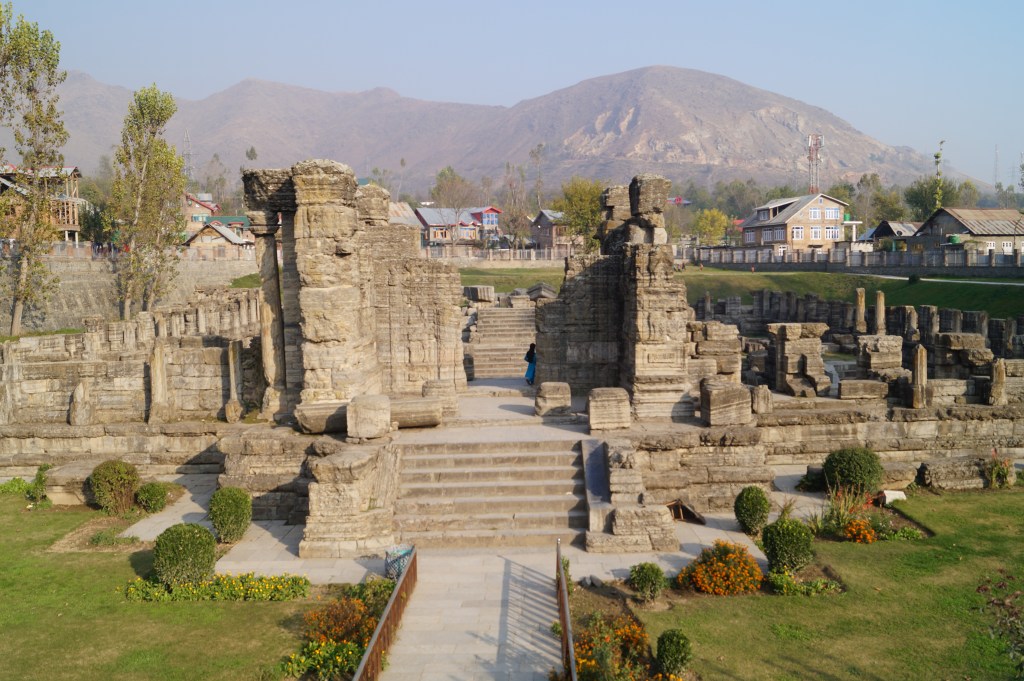
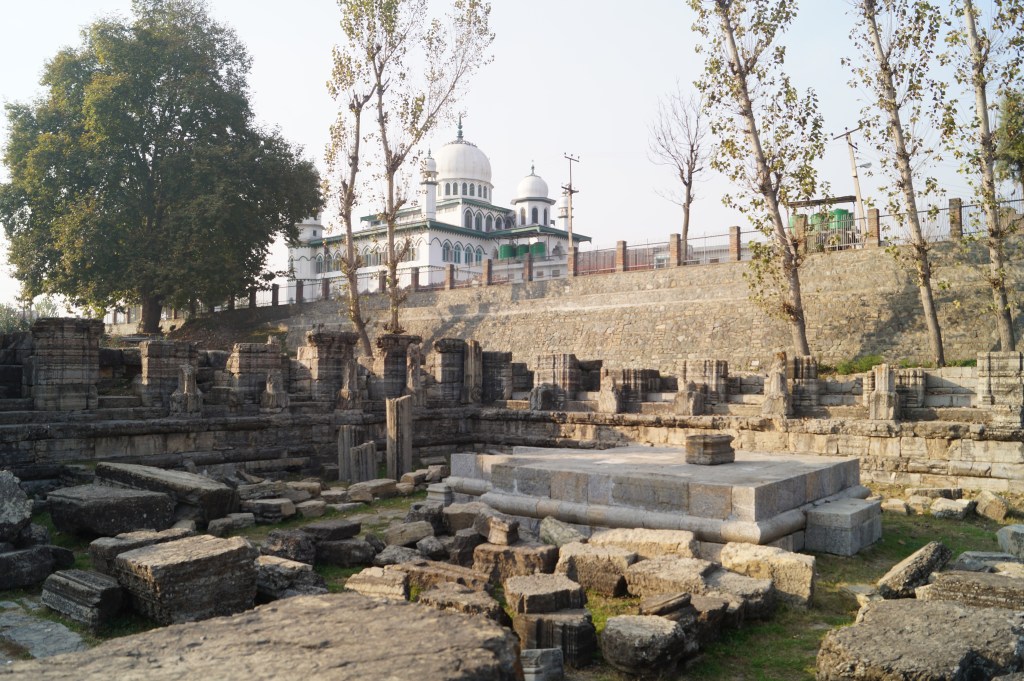
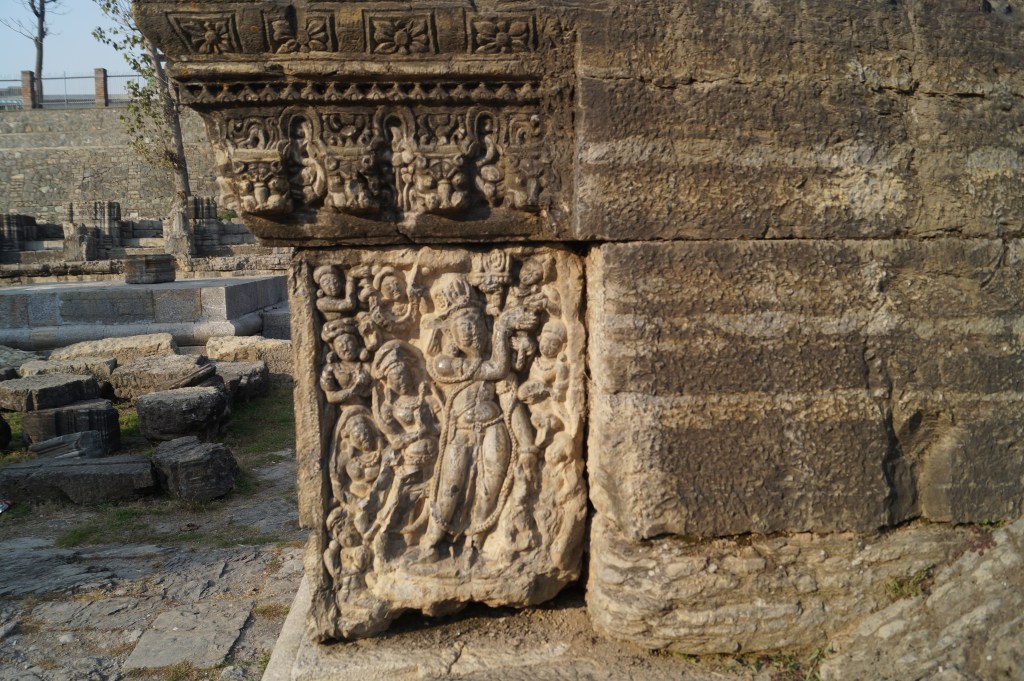
While passing through the town of Avantipora I caught sight of the magnificent white building of the Jama Masjid on the right side of the road. As it had to happen the angle of observation was such that in one sweep of my eye I could scan & internalize the grey ruins of the Awantiswami temple dampened by the nightly rain enclosed in an equally grey iron fencing – at a level lower than the national highway as if standing in a huge abandoned cavity in the earth, interspersed with leafless but a majestic Chinar as well as Poplar trees. The mosque stood at a higher elevation at the far edge of the cavity in which the ruins of the temple stood.
The visual effect & its impact triggered an old saying in my sub-conscious mind; ‘new civilizations are always built on the ruins of the old ones’. There couldn’t have been an apt & timely demonstration of the saying than the location of the ruins of the temple & the newly built mosque on the same physical plane.
The sweeping gaze of the two structures, one majestic even in ruin & the other in organically throbbing & majestic splendor, on that fateful cool spring afternoon led me to Avantivarman, one of the greatest Kashmiri Hindu Kings who ruled the Kingdom of Kashmir from 855 to 883 CE. A short distance away from this temple are the ruins of Avantiswara temple built by the same great king of Kashmir.
Avantivarman was the first king of the Utpala dynasty that ruled Kashmir after the end of the Karakota dynasty – the dynasty of King Lalitaditya, the builder of Martand temple dedicated to Sun.
Reign of Avantiverman (855 – 883 CE) was like a balm; not only on the aching body politic of the kingdom of Kashmir but also to its social & cultural life. This was the period when the king did not undertake any external expeditions. He used his time & resources to consolidate the internal security situation & concentrate on the development of his kingdom. The result was that the people during his reign were happy & prosperous.
In the beginning of his reign though, the king had to bring his own revolting & unruly brothers, cousins & nephews to book. There was trouble also from merchants who had acquired position bigger than that of the king on account of the wealth accumulated by them through unscrupulous means during the later period of the Karakota dynasty. In many cases they had also taken possession of some of the villages through their own retinues. In this task of kingdom building he was ably assisted by his minister named Sura who had also helped him in taking over as the King of Kashmir. He appointed his step-brother Suraverman as his Youvraj & assigned him powers to help him rule the kingdom justly.
One of the greatest achievements of the reign of Avantivarman was to make Kashmir reasonably free from the menace of perennial floods. In this endeavor he was ably assisted by Suyya, a practical engineer of his times. He had discerned the cause of the floods in Kashmir & then planned & weaved a solution that he thought was consistent with the psychology of the people. Though the people thought that Suyya was a mad person, as he would consistently narrate to everyone he came to know or came in contact with him that he had a solution for stopping perennial floods in the kingdom but didn’t have the resources. When the king came to know about it he provided him with Dinnara coins as per his requirement. Suyya went to the place called Yakshdara (present day Khadanyar) where boulders, unhinged from the adjacent mountains, had blocked the path of the waters of the river Jehlum. He threw the coins provided to him by Avantivarman into the river in full view of the villagers. The onlookers & villagers jumped to fish out & gather coins from the river & in the process removed the boulders that had blocked the flow of waters. The exercise was continued till the time flow of water became obstruction free. He followed it up by throwing the coins into the river & the mouths of the Wular Lake. People continued their “dutiful exercise” of fishing the coins out of the river along with sand & silt of the lake. In this process the river was dredged at the locations where silt & sand had settled down on the river bed or the lake thus causing floods. Suyya strengthened the embankments of the river were the chances of falling boulders from the adjacent mountains was more. He also stopped the flow of river for seven days with the help of a dyke & dredged the river in stretches that required removal of accumulated sand & silt. His method continued to be the same. He threw coins into the river & the villagers looking for the coins continued to dredge the river by bringing out basketfuls of sand & silt & depositing it along the embankments.
He constructed suitably designed canals to drain water from the swamps into the rivers thus bringing in more land under cultivation of agricultural products. A network of canals was created emanating from the rivers & streams & channelized for irrigation of land where eventually rice was grown.
A greater feat even by today’s standards was the creation of the confluence of Sindh & Jehlum at the present day place called Shadi Pora. It is said that earlier the area around present day Lar & Ganderbal of the Kashmir valley would get submerged because of the waters of Sind Nullah causing devastation during floods. These floods had laid the land in these areas completely waste.
These steps resulted in reduction of floods in the kingdom, the people produced bumper paddy & other crops and these commodities were available at considerably reduced prices. Kalhan mentions in Rajatarangni that the price of paddy for a particular local measure of weight (Khari) came down from Dinnaras 200 to Dinnaras 36. The price of one “Khari” of paddy during the later years of the reign of the kings of Karakota dynasty was around 1050 Dinnaras. In fact Lalitaditya Muktapida of Karakota dynasty had also taken some steps to control floods in the kingdom but they were abandoned by the later kings & in fact nothing was done to keep the already constructed facilities in operation.
Thus there was a sense of overall prosperity & wellbeing amongst the people of the kingdom. This resulted in enhancement of the popularity & prestige of the king.
King Avativarman along with Suryaverman, his stepbrother; Sura, his minister & Suyya, the engineer had put the kingdom of Kashmir on the path of peace, development & prosperity after a pretty long time in its history.
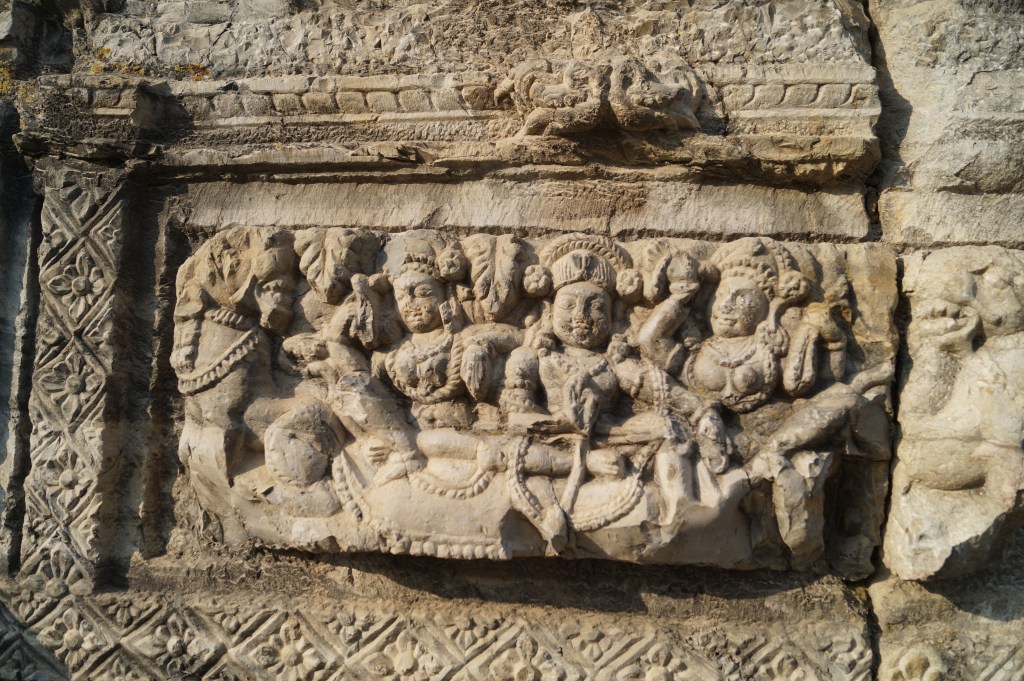
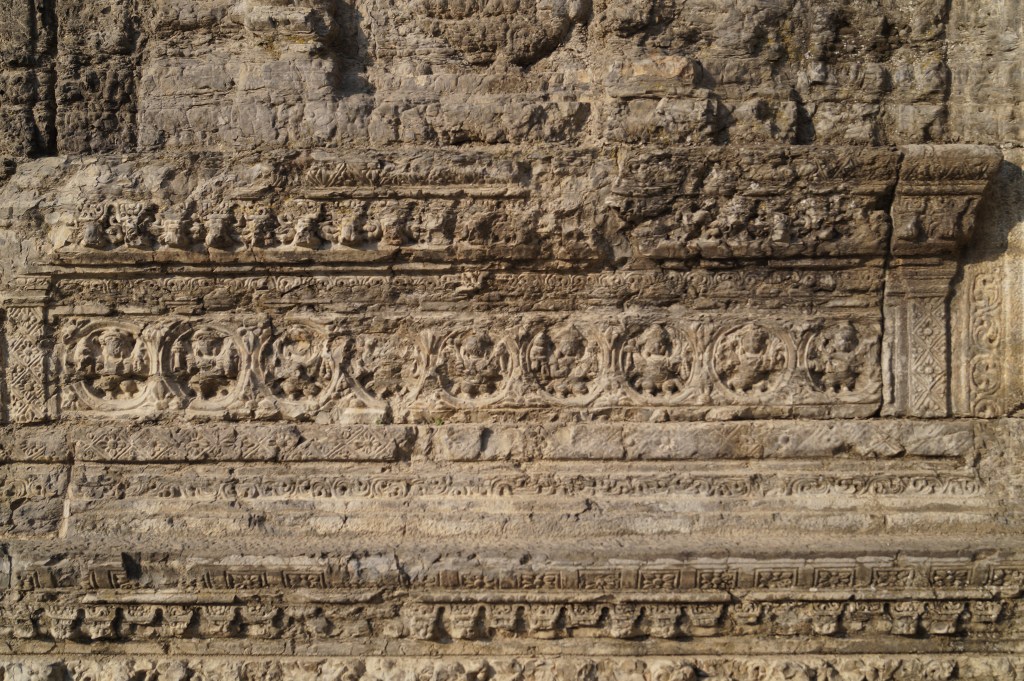
Prosperity also enabled diversion of the attention of the officials & ministers in the direction of construction of temples, viharas, muths & convents for piety. Before being crowned the king of Kashmir Avantivarman had already constructed the Avantiswamin temple – the ruins of which I had come across while travelling to Srinagar. After becoming the king he built the temple of Avantiswara. These temples were built by him in the town named Avantipura which was built by him. The name Avantipura for the town was derived from his own name by the king. This area was earlier called Visvaikaswra – which means a place that gives salvation to anyone who dies here. The town is located in one of the most picturesque spots in the Kashmir valley with river Jehlum skirting it on one side & on the other side are the hills gently sloping & merging seamlessly into the outer peripheries of the town giving it a serene look.
Some of the temples were constructed by Sura the most trusted minister of the king. Sura was so much devoted to the king that he was unmindful of his own life or that of his own family & was devoted to the wellbeing of the kingdom & the king.
He built a temple dedicated to Parvati & Shiva on the banks of the world famous Dal Lake in Srinagar. This temple is believed to have been constructed near the village of present day Ishber or Gupt Ganga. The temple was also provided with a permanent endowment. This area has continued to be a place of spiritual pursuits for Hindus especially following Kashmiri Shavism. Abhinav Gupta (950 – 1016 CE), the great Kashmiri philosopher, mystic, musician, dramatist, poet & proponent of the philosophy of Kashmiri Shavism is also belived to have lived here. Subsequently Swami Lakshman Joo (1907-1991 CE), a great philosopher of Kashmir Shaivism in his own right lived in Gupt Ganga in the Zabarvan Hills initially & later on at his ashram at Ishber – a few hundred meters from the famous Nishat gardens. Unfortunately, the great ascetic too did not remain unaffected by the turmoil in Kashmir of 1989/90 & finally passed away at NOIDA in the state of Uttar Pradesh in 1991. NOIDA, though in UP is on the periphery of Delhi.
Kavyadevi, wife of Sura also built a Shiva temple near Suresvari & named it Kavyadeviswara. Sura’s son, Ratnavardhan, too built a temple of Bhuteshwara in the same area with a convent inside the Suramonestry. Sura also established a town near present day Shopian named Surapora which today is called Hir Pora. Those days this territory was called Kramavarta & it is quite possible that Kulgam today has connotation of the same name.
Principal doorkeeper of Sura named Mahodaya also built a temple built Mahodayaswamin.
Not to be left behind the step brother of the king & Youvaraj, Suraverman, also built Suravarmaswamin & Gokula temples. He granted “agraharas” of Khadhuya & Hastikarna.
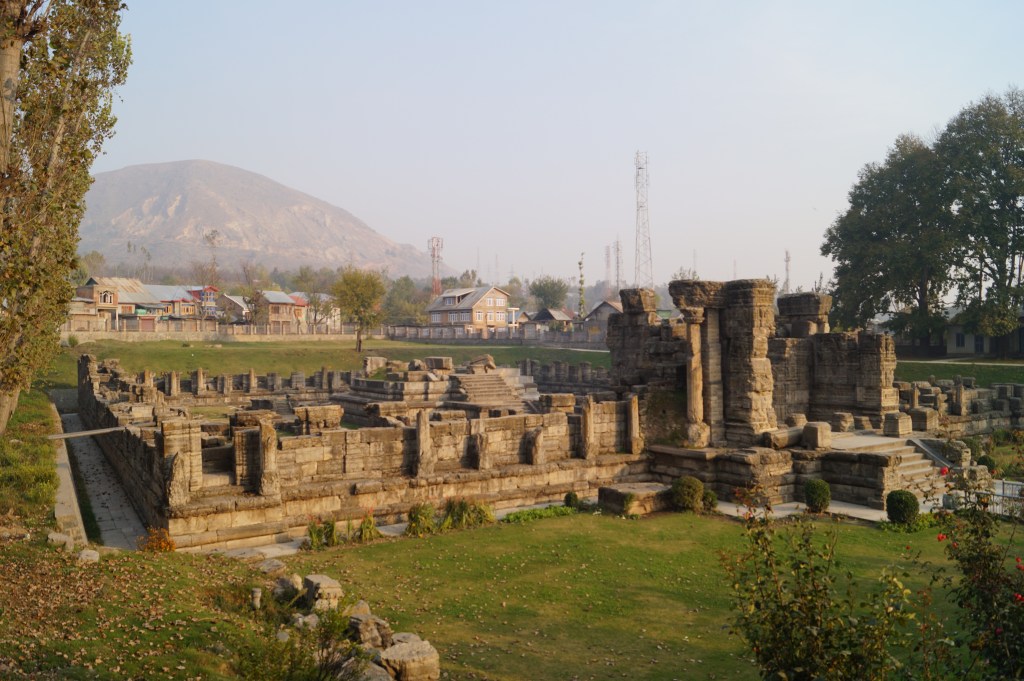
In short, during the reign of Avantiverman many temples & towns were built by the members of the royal family, the Youvraj & the ministers thus giving an impetus to the economic activity. A few of these places exist as ruins even today & where ruins are nonexistent the philosophy & association of Kashmiri Shaivism has continued to be a part of those pockets such as Ishber & Gupt Ganga on the banks of the Dal Lake.
Sura once again started the spread of education that had got once again stalled because of turmoil & unsettled conditions of the kingdom of Kashmir. He made it a point to honour the men of letters & made them members of the king’s council. Some of the poets mentioned by Kalahana in Rajatarangni, who were made members of the kings council by Sura were Muktakana, Sivasvamin, Anandavardhan & Ratnakara.
They were given special privileges & incentives to encourage them to pursue matters of scholarship.
Kalhan in Rajatarangani mentions that Ramata, famous for work on grammar, was appointed a preacher in a temple.
Avantiverman banned slaughter of animals for a period of ten years in the beginning of his reign. Why this period was fixed as ten years & what happened thereafter is not known. Killing of birds in the present day Wular Lake called Mahapadma was also prohibited by Suyya. This lake became a sanctuary for birds of various types & variety.
Suyyabuit a town downstream of the outlet of the Mahapadma Lake & named it Suyyapur which in modern times is famous by the name of Sopore. Suyya’s mothers name was Suyya too. He built a bridge over river Jehlum in her name. It is said that the lady, Suyya, who belonged to Chandala caste, had found a newborn baby in an earthen pitcher the mouth of which was covered with a lid. After enquiring about the mother of the child when no one came to claim him she took this child to her home & brought him up in poverty & misery. This child was also named Suyya after his mother (the lady who had adopted him). However, he proved to be well ahead of his times & was able to resolve the perennial problem of flooding in the kingdom of Kashmir. Some lesson for engineers, town planners & administrators who could neither foresee nor prevent or manage the city of Srinagar during the floods of 2014. It is worthwhile to understand that Suyya had neither the education nor the knowledge, technology or resources in the 9th century CE that were available to the administrators & engineers of Kashmir in 2014. Suyya didn’t have the advantage of Google maps, drones, internet or technological tools that are available to us now but still was able to make Kashmir reasonably free from perennial floods. Suyya was committed person & that is the truth.
When time came, Avantivarman realized that he was not going to live any longer. He retired to Jyesthesvara (present day Shankracharya) & while listening to verses from Bhagwat Gita left this world.
 JAGMOHAN SHARMA
Fascinating history. We know so little about past. Thank you very much sir for such enlightening posts
LikeLike